Key takeaways
- The mmHg on the package is an ankle pressure, not a whole-leg pressure. In the Sigel reference profile a stocking rated 18 mmHg at the ankle delivers 14 at mid-calf and 8 behind the knee. The falling gradient is the mechanism, so a sock that feels equally tight from ankle to knee is not doing the job the label describes.
- The retail bands are mostly not the classes used in the research. The two-hour standing trial compared class I at 18-21 mmHg with class II at 23-32 mmHg, and neither maps onto 15-20 or 20-30. A single 12-hour shift study in Human Factors is the exception: it randomised standing workers to regular socks, 15-20 or 20-30 mmHg, and found both bands held off the fatigue and swelling the sock group developed, with no advantage to the firmer one.
- Firmer measured better and wore worse. In that trial the firmer class produced the least lower-leg swelling, while the milder class was rated more comfortable and judged more likely to be worn long term. A sock left in a drawer delivers nothing at all.
- Sizing is a calf problem, not a shoe-size problem. In a 2026 study of stockings fitted across two hospitals only 14 percent fitted correctly, leg measurements were skipped in 44 percent of cases, and foot size correlated with calf circumference at just 0.27.
- 20-30 mmHg is the band StatPearls names for diagnosed varicose veins, rising to 30-40 in more severe cases. That is a clinician's recommendation for a condition, not a default setting for a healthy nurse, so take that step with your own clinician rather than a size chart.
For a healthy nurse new to compression on twelve-hour shifts, 15-20 mmHgmmHgMillimeters of mercury, the pressure unit used to rate compression socks and blood-pressure readings. Compression hosiery is sold in bands - commonly 8-15, 15-20, 20-30 and 30-40 mmHg - and the number describes pressure at the ankle, not an average over the whole leg. is the usual starting band and 20-30 mmHg20-30 mmHgThe firm band of compression hosiery, often labelled by sellers as 'medical grade' - a marketing phrase, not a regulatory classification. It is harder to don than 15-20 mmHg and is frequently the band nurses report their own clinicians discussing. Which band suits a given person is a question for that person's clinician, not a review site. is the step up if a fair trial does nothing; anything firmer, or any known vein or circulation condition, is a conversation with your clinician first. Every compression sock is sold on one number. Fifteen to twenty. Twenty to thirty. The number is real and it is measured — but it is a pressure reading taken at a single point on your leg, not a description of how the whole sock feels. Knowing which point, and what happens above it, is most of what separates a sock you wear every shift from one you wear twice and abandon in a drawer.
This is the decision, not the shopping list. If you already know your class, our compression sock comparison ranks the socks themselves.
mmHg is the pressure unit off your own cuff — millimetres of mercury, the same scale as the blood pressure you chart. A sock labelled 15-20 mmHg is stated to deliver between 15 and 20 mmHg. At the ankle. Not at your calf, and not behind your knee.
The label is an ankle number, and the leg above it gets much less
Graduated compressiongraduated compressionCompression that is strongest at the ankle and eases as it travels up the calf. The gradient is what distinguishes a compression sock from a merely tight sock. Manufacturers state the ankle band in mmHg; independent verification of the gradient across the leg is rare, so treat the stated band as a manufacturer claim. means the pressure falls as it travels up the leg, and that gradient is the entire mechanism. A UK health technology assessment states it directly: graduated compression stockings exert graded pressure at a decreasing gradient from ankle to thigh, which increases blood flow velocity and promotes venous return. The same document publishes the reference gradient — the Sigel profile — that turned compression from a tight sock into a measured therapy.
| Where on the leg | Pressure in the Sigel reference profile |
|---|---|
| Ankle | 18 mmHg |
| Mid-calf | 14 mmHg |
| Knee, at the popliteal break | 8 mmHg |
| Lower thigh | 10 mmHg |
| Upper thigh | 8 mmHg |
Read down that column and the useful fact falls out on its own: a stocking whose headline number is 18 delivers 8 at the knee. That profile was found to raise deep venous flow velocity by 75 percent, and it does it by falling away — not by squeezing hard everywhere. A sock that feels identically tight from ankle to knee is not a graduated sock. It is a tight sock, and the tightness at the top is what makes you take it off at hour seven. The standards do not even agree on how many points to measure: the same assessment notes the British Standard for antiembolism stockings requires three, where Sigel specified five.
15-20 and 20-30 are retail bands, not the classes in the research
The bands on the packaging are marketing conventions. The clinical literature uses compression classes, and the two do not line up.
- 15-20 mmHg — the mild band, where most over-the-counter socks aimed at people on their feet all day sit. No prescription, no fitting appointment, sold in multi-packs.
- 20-30 mmHg — the firm band. StatPearls, on conservative management of varicose veins, states the recommended graduation is 20-30 mmHg, rising to 30-40 in more severe cases. That is a treatment recommendation for a diagnosed condition — a different question from what to wear on a med-surg floor.
- 18-25 mmHg and similar — vendor bands sitting between the two. Not a recognised class; a knit that measured where it measured.
Now hold those against the research. The two-hour standing trial in Applied Ergonomics tested class I at 18-21 mmHgmmHgMillimeters of mercury, the pressure unit used to rate compression socks and blood-pressure readings. Compression hosiery is sold in bands - commonly 8-15, 15-20, 20-30 and 30-40 mmHg - and the number describes pressure at the ankle, not an average over the whole leg. and class II at 23-32 mmHg. Neither is 15-20. Neither is 20-30. They straddle both. Anyone telling you a study proved 20-30 is better for nurses is folding two different scales into one sentence.
One trial is the exception, and it is the one worth knowing. A 2023 trial in Human Factors randomised 40 security guards to regular socks, 15-20 mmHg or 20-30 mmHg20-30 mmHgThe firm band of compression hosiery, often labelled by sellers as 'medical grade' - a marketing phrase, not a regulatory classification. It is harder to don than 15-20 mmHg and is frequently the band nurses report their own clinicians discussing. Which band suits a given person is a question for that person's clinician, not a review site. stockings and measured lower-leg muscle twitch force, leg volume and discomfort across their regular 12-hour standing shift. The regular-sock group finished with significant muscle fatigue, swelling and discomfort. Neither compression group showed a significant change in any of the three. Because the two bands performed alike, the authors conclude the lower level may be sufficient. Read the limits with it: the participants were all male, they were guards rather than nurses, and the groups were small. It is still the closest thing in the literature to a head-to-head test of the two numbers on the packet, at a shift length that matches the job. How long to keep them on once you have picked a band is a separate question, and we answer it in how long to wear compression socks.
What the standing research actually measured
The Applied Ergonomics pilot was a randomised cross-over: 32 healthy participants and 12 with chronic venous insufficiency, each standing two hours under three conditions — nothing, class I, class II — with swelling quantified by water plethysmography and bioelectrical impedance. Both classes significantly reduced swelling. The least swelling came with the firmer class II. Wearing comfort was rated slightly better for class I, and the authors conclude class I may lead to better long-term compliance.
The falsifiable version: firmer wins the measurement and loses the wearing. If "more mmHg is better" were simply true, that comfort finding would not exist. A sock in the drawer delivers 0 mmHg, which loses to every other option on this page.
The second study is closer to a career than a shift. A 12-month randomised controlled trial in International Angiology followed 75 healthy healthcare professionals on six-hour standing shifts, with and without graduated compressiongraduated compressionCompression that is strongest at the ankle and eases as it travels up the calf. The gradient is what distinguishes a compression sock from a merely tight sock. Manufacturers state the ankle band in mmHg; independent verification of the gradient across the leg is rare, so treat the stated band as a manufacturer claim.. Leg volume rose in the no-stocking group and fell in the stocking group at every assessment point across the year; vein-specific quality-of-life scores worsened without and improved with.
Most sizing failures are calf failures, not shoe-size failures
Here is the number that reframes the purchase. A 2026 cross-sectional study across two Darwin hospitals measured how well graduated compression stockings were actually fitted. Of 43 people assessed, only six — 14 percent — wore stockings that fitted correctly by the manufacturer's own recommendations, and leg measurements had not been taken at all in 44 percent of cases before application. The correlation between foot size and calf circumferencewide calfCompression sock sizing based on measured calf circumference rather than shoe size alone. Brands that publish a two-axis chart (shoe size plus calf measurement) produce far fewer 'cut into my leg' and 'rolled down' reports than brands that publish shoe size only. was 0.27.
That is hospital-issued stockings fitted by staff who do it constantly. If the correct-fit rate is 14 percent there, a sock ordered off a shoe-size chart at 23:00 is not doing better. Rho of 0.27 is the figure to carry: your foot tells you almost nothing about your calf. Measure once, and keep the numbers in your phone.
- Measure first thing in the morning, before the leg has had a day to swell.
- Ankle at the narrowest point, just above the bone.
- Calf at the widest point, standing, tape snug but not compressing.
- Read the calf column before the shoe-size column. If they disagree, the calf wins. If your calf sits outside the chart, buy a model built wide rather than sizing up — sizing up mostly adds length.
Matching a class to a sock
Five socks in our catalogue cover the honest span of this decision.
| Stated class | Sock | What the listing states about fit |
|---|---|---|
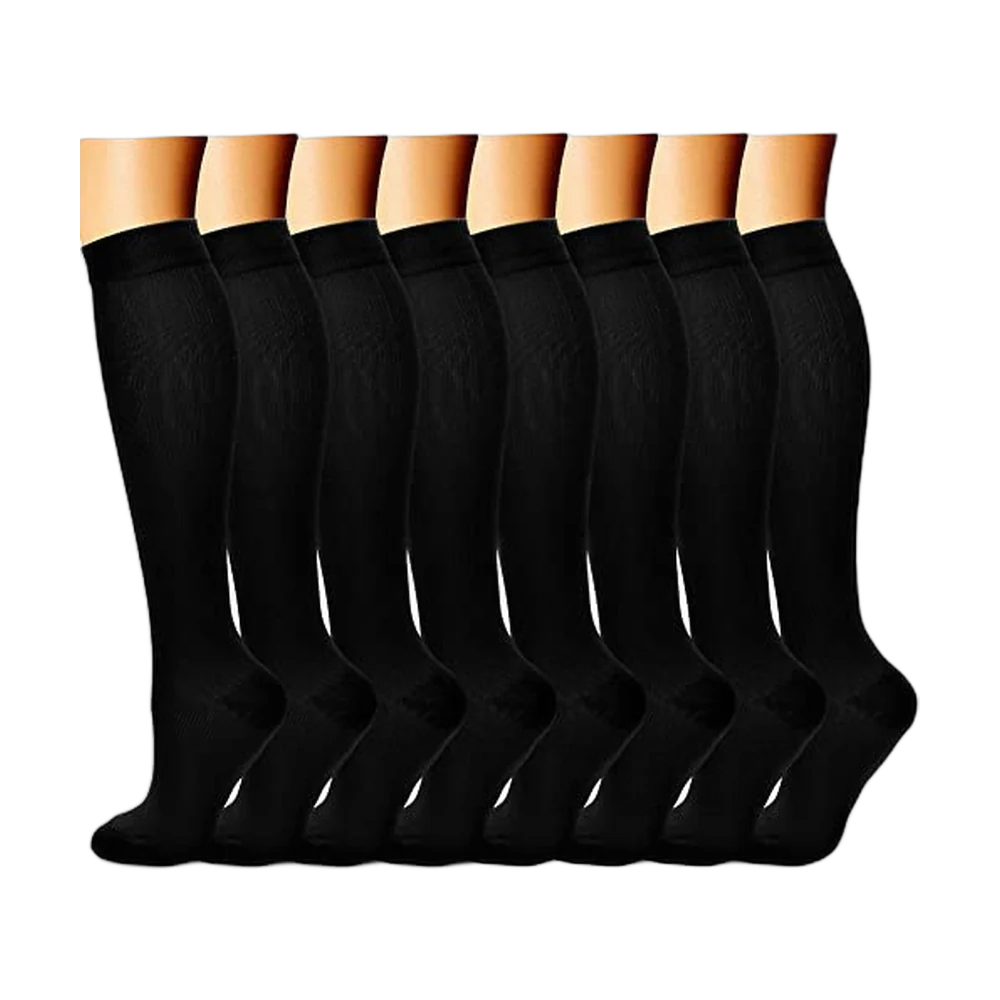
| 15-20 mmHg | CHARMKING, 8 pairs | Knee-high wide calf; this listing is L/XL, sized from the chart image |
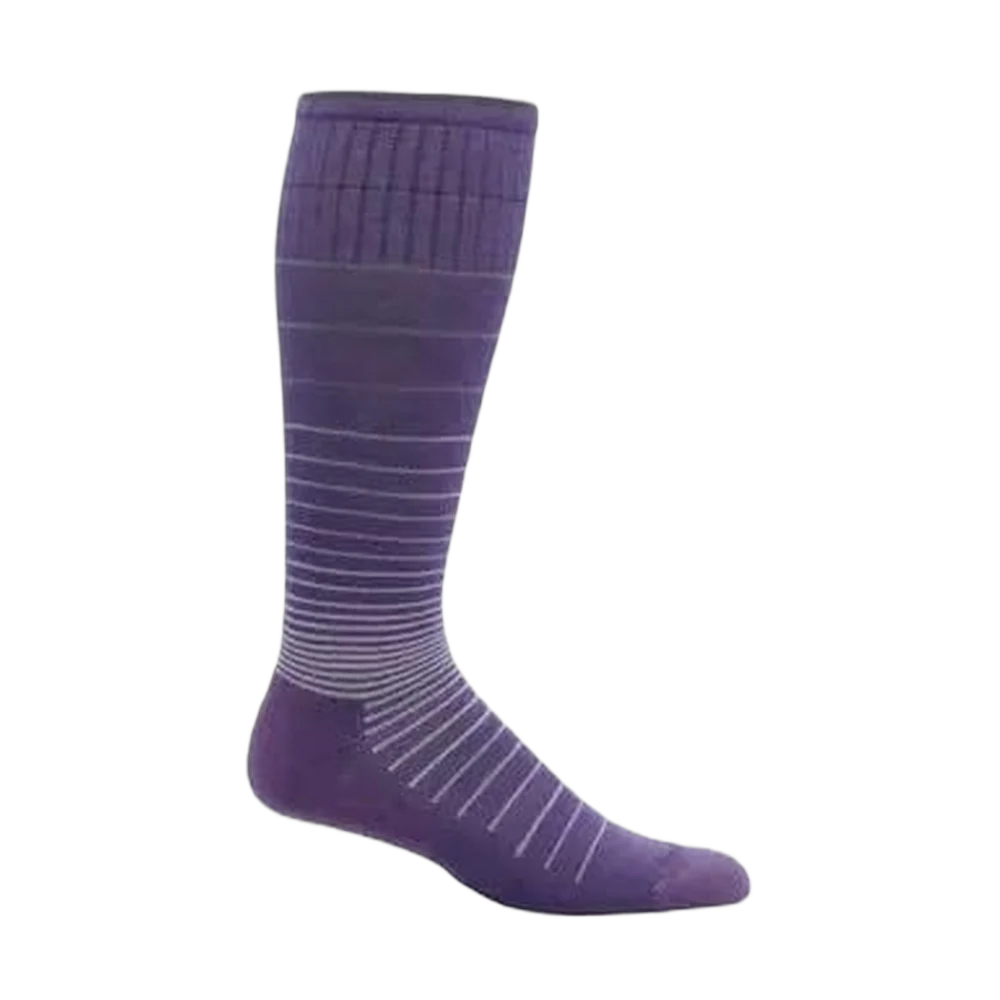
| 15-20 mmHg | Sockwell Circulator | Sized by shoe size with a turn-welt top; no calf circumference published |
| 15-20 mmHg | Comrad knee-high, 3-pack | Charted by shoe size and calf circumference — the only one publishing both |
| 18-25 mmHg | Wellow bamboo | Regular-calf MD listing: designed for an 11.5 inch calf, stretching to 19 |
| 20-30 mmHg | Physix Gear Sport | Knee-high, sized by shoe size range; no calf circumference published |
Which is to say:
- Never worn compression, tired legs, twelve-hour shifts → mild band, multi-pack, because the benefit tracks days worn.
- Mild genuinely feels like nothing after a fair trial → step up a band rather than sizing down, which is the wrong lever.
- Calf outside every chart → a purpose-built wide model at a mild class beats a firm class you cannot get past your ankle.
- A vein a clinician has already named → that is a fitting conversation, not a size chart.
Care, rotation, and where this stops being a gear question
Elastic knits shed stated pressure with wear and washing, so the class you bought is not the class you are wearing two years on. The fix is unexotic:
- Wash them. Twelve hours on a leg makes a sock a laundry item, not a shoe.
- Own enough pairs that laundry day never becomes a day without.
- Replace on feel — when a sock goes on easily and leaves no mark, it has stopped working.
- Put them on before the shift, not after the swelling.
The line we do not cross. We research gear; we are not your clinician. Anything above the mild band — and anything at all if you have diabetes, peripheral arterial disease, neuropathy, an existing clot, or a vein a clinician has commented on — is a conversation with that clinician, not a purchase. Compression is a therapy with contraindications, and the Darwin study recorded adverse events in nearly a third of the people who were wearing it against one.
The honest summary is smaller than the search volume suggests. For a healthy nurse on a hard floor the class is a starting point, not an answer: begin mild, size to the calf rather than the foot, own enough pairs to make it daily, and step up only if a fair trial genuinely does nothing. The research is far more confident that wearing compression beats not wearing it than that any particular band is right for you.
| Study | Who | Pressures compared | What it reported |
|---|---|---|---|
| Applied Ergonomics, 2025 (pilot, randomised cross-over) | 32 healthy adults + 12 with chronic venous insufficiency, two hours standing | None vs class I (18-21 mmHg) vs class II (23-32 mmHg) | Both classes significantly reduced lower-leg swelling; least swelling with class II; comfort rated slightly better for class I, which the authors say may give better long-term compliance |
| International Angiology, 2023 (randomised controlled trial, 12 months) | 75 healthy healthcare professionals working six-hour standing shifts | Graduated compression vs none | Leg volume rose without stockings and fell with them at every assessment point; vein-specific quality of life worsened without and improved with |
| Human Factors, 2023 (randomised, three parallel groups) | 40 male security guards, measured across a regular 12-hour standing shift | Regular socks vs 15-20 mmHg vs 20-30 mmHg (the retail bands themselves) | Significant muscle fatigue, leg swelling and discomfort after the shift in the regular-sock group only; no significant change in either compression group; the authors conclude the lower level may be sufficient |
| NIHR health technology assessment (Sigel reference profile) | Reference pressure profile for graduated stockings | 18 mmHg ankle, 14 mid-calf, 8 knee, 10 lower thigh, 8 upper thigh | Reported to increase deep venous flow velocity by 75 percent; British Standard measures three points where Sigel specified five |
| J Vasc Surg Venous Lymphat Disord, 2026 (cross-sectional, two hospitals) | 43 admitted patients assessed for stocking fit | Fit against the manufacturer's own recommendations | Only 6 of 43 (14 percent) correctly fitted; leg measurements not taken in 44 percent; foot size vs calf circumference correlation 0.27 |
| StatPearls, Varicose Veins (conservative management) | Patients with diagnosed varicose veins | 20-30 mmHg, rising to 30-40 mmHg | States 20-30 mmHg as the recommended graduation, elevated to 30-40 mmHg in more severe cases |
Products discussed in this article
Every item named above, with the NurseComforts Score and the price we last recorded. Prices at the affiliate retailers we link change constantly.
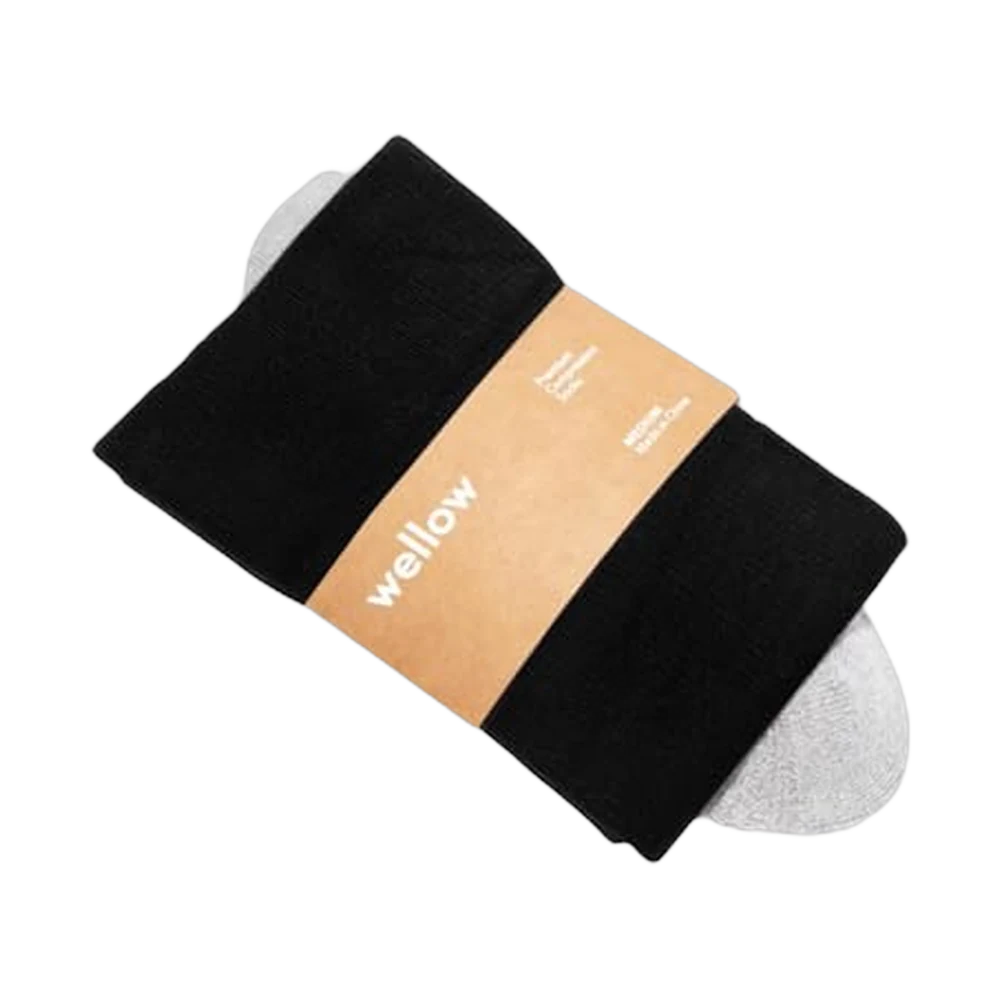
Wellow 18-25 mmHg Bamboo Compression Socks
67 · Score$31.99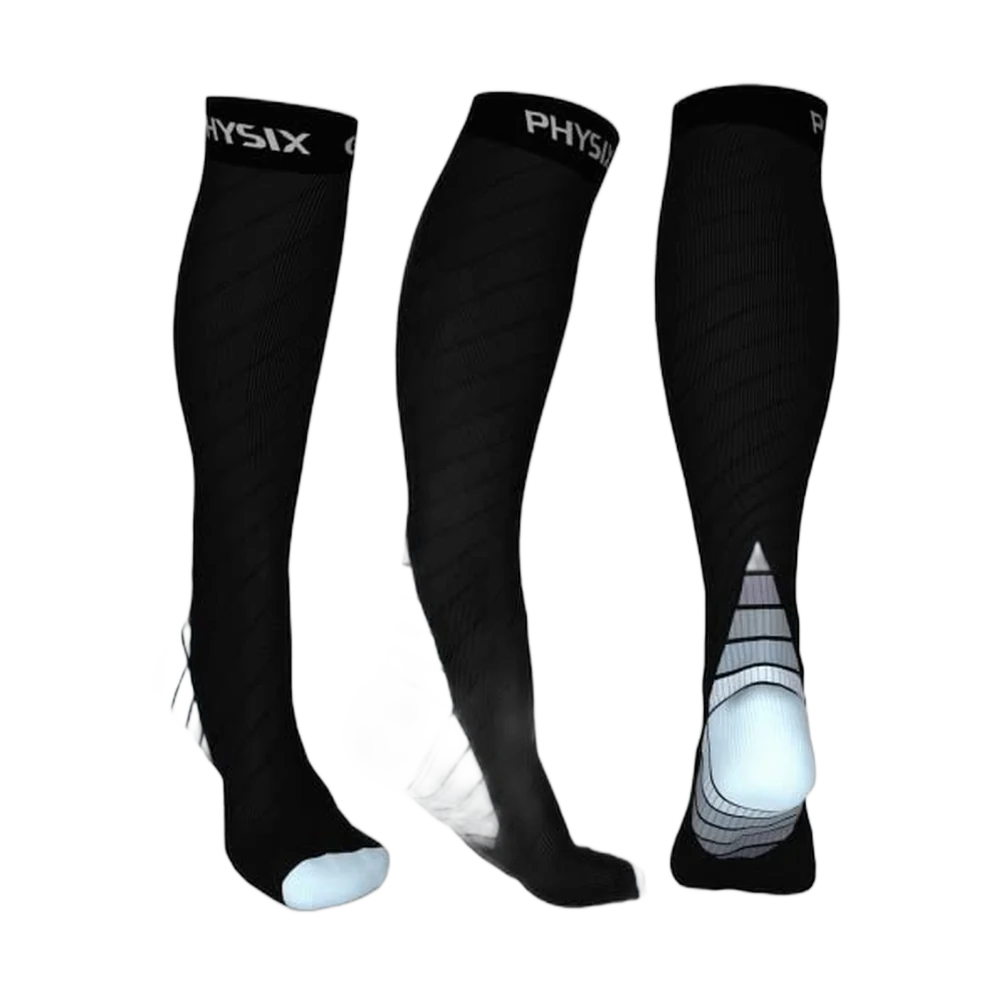
Physix Gear Sport 20-30 mmHg Compression Socks
78 · Score$18.82
Your next step
Know your class? Here is where to size it, and what else the same shift is doing to your legs.
Common questions
Is the mmHg number on the package measured at the ankle?
Are 15-20 and 20-30 mmHg the same as compression class I and class II?
Is more compression always better for a twelve-hour shift?
Why do compression socks that match my shoe size still cut into my calf?
Do I need to speak to a clinician before buying 20-30 mmHg socks?
Research Sources
- Background - graduated compression mechanism and the Sigel pressure profile | NIHR Health Technology Assessment, NCBI Bookshelf
- Varicose Veins - conservative treatment, recommended graduation of 20-30 mmHg | StatPearls, NCBI Bookshelf
- Influence of compression stockings with different compression classes on lower leg edema and perceived discomfort during a two-hour static standing exposure | Applied Ergonomics, 2025
- Comparison of physiological effects induced by two compression stockings and regular socks during prolonged standing work - 12-hour shift trial of 15-20 and 20-30 mmHg | Human Factors, 2023
- Randomized controlled trial on occupational graduated compression clinical and cost-effectiveness in standing healthcare workers | International Angiology, 2023
- A cross-sectional study of the use of graduated compression stockings at two top end hospitals in Darwin, Australia | Journal of Vascular Surgery: Venous and Lymphatic Disorders, 2026