Quick Answer
Compression socks should feel tight, with the most pressure at the ankle and less higher up the leg, per MedlinePlus. They should not hurt. Pain, numbness, tingling, or a pale, cool or discolored foot means take them off and sort out the fit, and talk to a clinician if those signs do not settle.
Key takeaways
- MedlinePlus says compression stockings should feel tight, with the most pressure at the ankle. Hard to pull on is not a fault by itself.
- Numbness, tingling, pins and needles, pain, or a pale, cool or discolored foot are the too-tight signs listed in NHS hospital guidance.
- We could not trace any clinical threshold for how deep a sock mark can be. Persistent pressure marks go to a doctor, per medi.
- mmHg labels do not settle fit: class II means 18-24 mmHg on the British Standard and 23-32 on German RAL, per NHS Devon.
- Peripheral arterial disease and neuropathy are on NHS lists of reasons not to offer stockings, so ask a clinician before judging fit yourself.
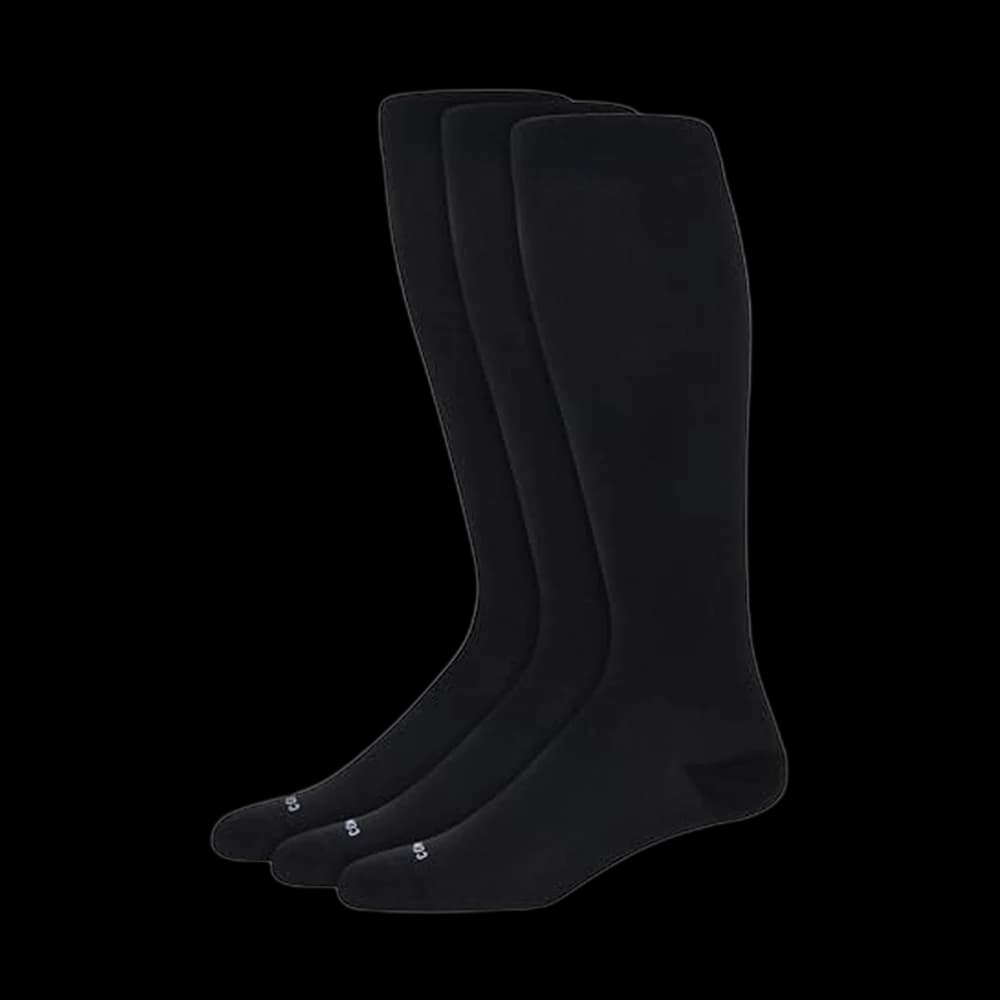
Comrad Knee-High Compression Socks, 3-Pack
- True graduated 15-20 mmHg, strongest at the ankle and easing up the leg
- Sized by shoe size and calf circumference together, so you can measure rather than guess
- SmartSilver treatment targets odor, which matters on back-to-back shifts
If fit is your problem, this sock lets you measure: true graduated 15-20 mmHg, charted against calf circumference as well as shoe size. It costs far more per pair than a budget pack.
Side-by-side comparison
#1Comrad Knee-High Compression Socks, 3-Pack Owner rating4.3(565) | #2JOBST Relief 15-20 mmHg Knee High Owner rating4.4(1,643) | |
|---|---|---|
| 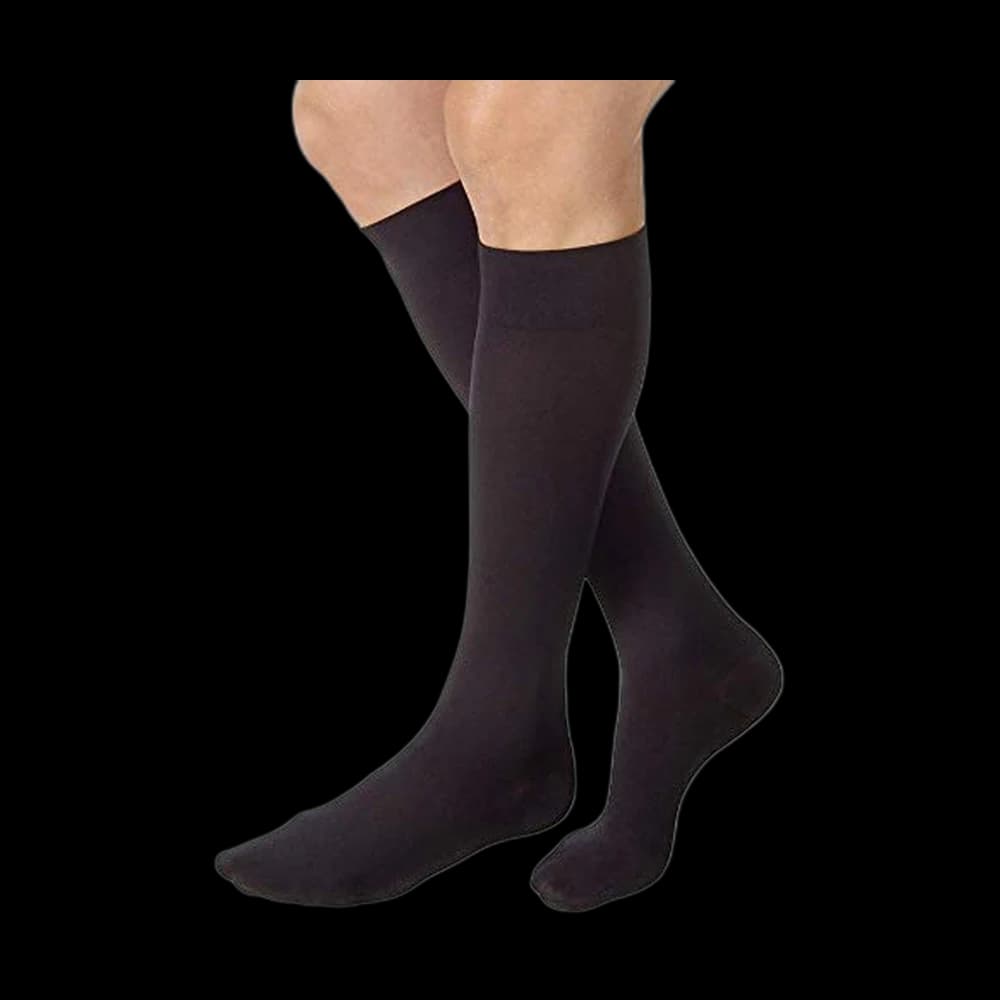 | |
| NurseComforts Score | ||
| Verdict | True graduated 15-20 mmHg with sizing charted against both calf circumference and shoe size. | A single everyday 15-20 mmHg pair sized by ankle and calf circumference rather than shoe size. |
| Price | ~$101.99Buy on Amazon Price checked Nov 1 | ~$32Buy on Amazon Price checked Nov 1 |
| Compression Level (mmHg) | 15-20 mmHg, true graduated | 15-20 mmHg, graduated, as JOBST states |
| Fiber Content | 91% nylon, 9% spandex with SmartSilver | Not stated on the listing |
| Pairs Per Pack | 3 pairs | 1 pair |
| Buyer sentiment | Quality Compression Comfort Buyers praise quality, compression and comfort. Mixed feedback on fit and ease of use. Based on 259 user mentions | - |
| Pros |
|
|
| Cons |
|
|
* Prices are approximate. Click Buy to see current pricing on Amazon.
Tight enough that you notice it, firmest at the ankle, and never painful. MedlinePlus says compression stockings should feel tight, with the most pressure around your ankles and less higher up your legs. Pain, numbness, tingling or a color change is the line, and no brand's size chart overrides it.
Where the usual advice goes soft. Most top results for this question are sock sellers. Sockwell describes the feel as a "gentle hug", which is friendlier than the National Library of Medicine's plain "tight". Expect a real squeeze. Then judge it by the signs below, not by whether it feels pleasant.
Run this check an hour into your shift
| Check | About right | Too tight | Too loose |
|---|---|---|---|
| Overall feel | Tight, most pressure at the ankle (MedlinePlus) | Pain or soreness in the foot or leg (Bedfordshire Hospitals) | No pressure felt at the ankle (Sockwell) |
| Foot and toes | Toes wiggle freely (Sockwell) | Numbness, tingling, pins and needles; pale, cool or discolored foot (Bedfordshire Hospitals) | No sign listed |
| Top of the sock | Two fingers below the knee bend (MedlinePlus) | Rolled down, forming a tight band that restricts flow (Bedfordshire Hospitals) | Slides down (Sockwell) |
| Fabric | Smoothed, no wrinkles (MedlinePlus) | Top folded over, which Cleveland Clinic says not to do | Bunches at the knee (Sockwell) |
| Skin afterward | No clinical source we read defines this | Lingering red lines (Sockwell) | No sign listed |
Weigh those sources honestly. Bedfordshire's leaflet covers anti-embolism stockings after surgery, and Sockwell sells socks. We found no clinical authority writing specifically about over-the-counter socks on a shift, so this is the closest public guidance, assembled in one place.
The sock-mark question has no clean answer
Retailer pages often give a verdict on marks. We could not trace those verdicts to a clinical threshold for how deep a mark can be or how long it can last, so we will not invent one.
What we can source is narrower:
- Friction is a common cause. medi, writing about the top band on its medical stockings, says reddened skin under the band often comes from sweat and mechanical friction, and that lifting and moving the band usually solves it.
- Persistence changes the answer. The same page says persistent pressure marks or irritation should go to a doctor.
- Symptoms outrank appearance. A mark with pain, numbness or tingling is a stop signal. Cleveland Clinic says to talk to your provider right away about those, and about skin changes such as redness or irritation.
Hard to pull on is not the same as too tight
These are two separate problems with two separate fixes. MedlinePlus treats difficulty getting stockings on as ordinary and gives a list of workarounds.
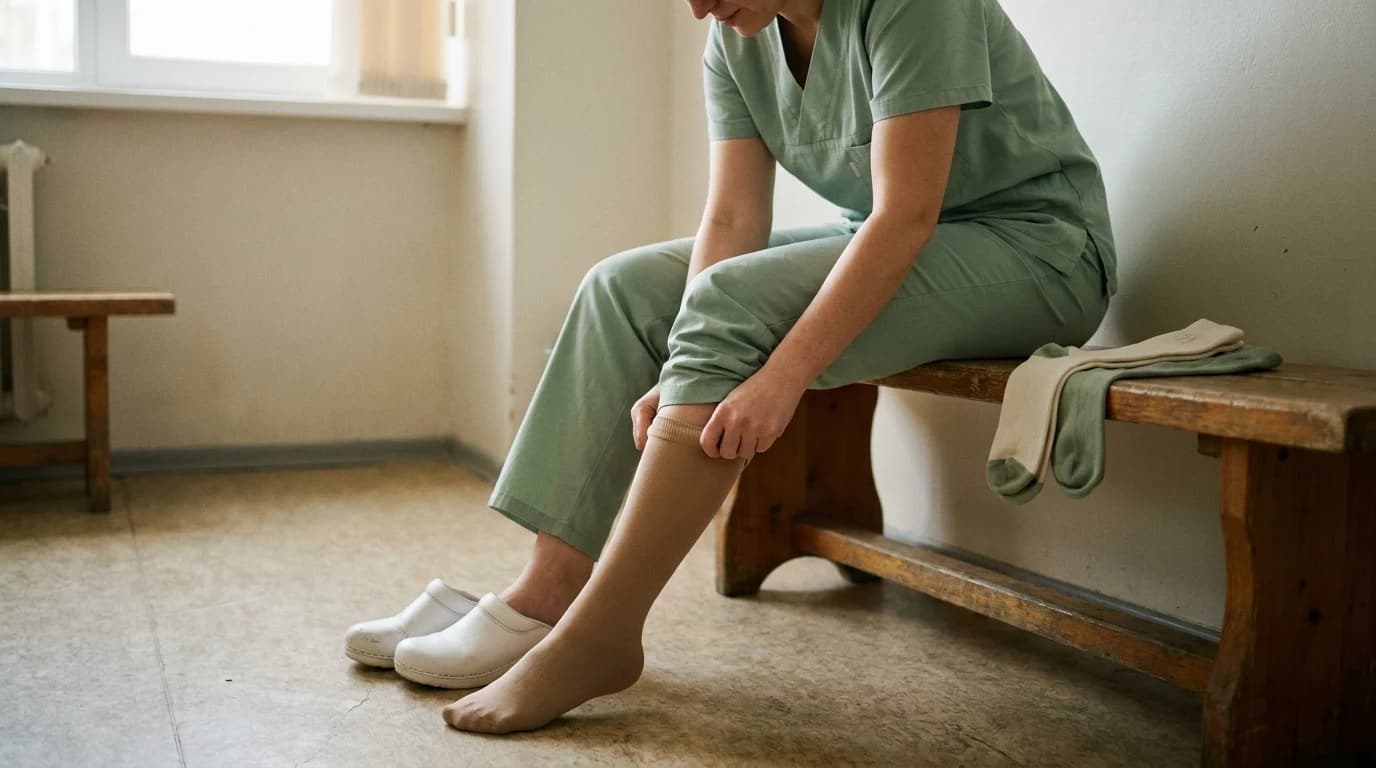
- Struggle on the way on, fine once on: technique. Put them on first thing, before you get out of bed. Let lotion dry fully or use a little cornstarch, wear rubber gloves for grip, or try a stocking donner.
- Easy to get on, painful once on: fit or pressure. Technique will not fix this one, so go to the steps below.
If they are too tight, change one thing at a time
- Take off a sock that causes symptoms. Bedfordshire's leaflet says that at home you should remove stockings immediately and call for advice if symptoms have not gone within an hour. If yours were prescribed, MedlinePlus says to contact your provider about a different stocking rather than quietly stopping.
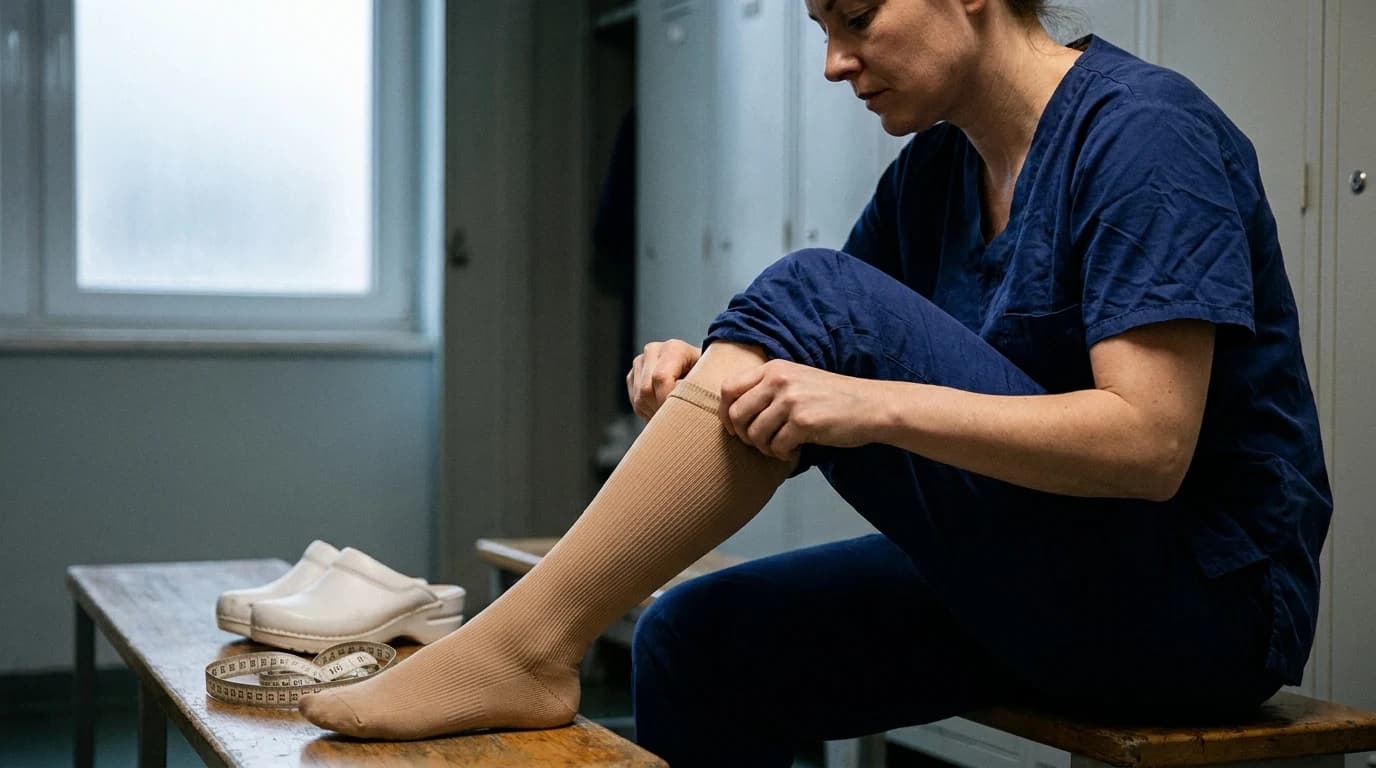
- Check the application. Look for wrinkles, a folded top and a rolled band. Each is a fault in how the sock sits, so rule these out before you buy anything.
- Measure again. Use a tape, not your shoe size. In a study at two Darwin hospitals, only 6 of 43 assessed patients wore stockings that fit by the maker's recommendations, and legs had gone unmeasured in 20 cases. Our size finder covers where each brand measures.
- Read that brand's chart. Sizes do not transfer. The Comrad knee-high is charted by calf and shoe size, while JOBST Relief is sized by ankle and calf.
- Then consider a lower band. A 12-hour shift trial of 40 male security guards found similar benefits at 15-20 and 20-30 mmHg20-30 mmHgThe firm band of compression hosiery, often labelled by sellers as 'medical grade' - a marketing phrase, not a regulatory classification. It is harder to don than 15-20 mmHg and is frequently the band nurses report their own clinicians discussing. Which band suits a given person is a question for that person's clinician, not a review site., and its authors say the lower level may be sufficient. That is one small trial outside nursing, but it is a reason not to treat firmer as better.
The number on the box will not settle it
Cleveland Clinic notes there is no standard scale for rating compression stockings. Put three common scales side by side and the same word covers different pressures.
| Scale (mmHg) | Lowest tier | Middle tier | Top tier shown |
|---|---|---|---|
| Cleveland Clinic's general categories | Low: under 20 | Medium: 20-30 | High: over 30 |
| British Standard, per NHS Devon | Class I: 14-17 | Class II: 18-24 | Class III: 25-35 |
| German RAL, per NHS Devon | Class I: 18-21 | Class II: 23-32 | Class III: 34-46 |
So a "class II" stocking can mean 18-24 or 23-32 depending on the standard. Cleveland Clinic also says stockings rated 20 mmHgmmHgMillimeters of mercury, the pressure unit used to rate compression socks and blood-pressure readings. Compression hosiery is sold in bands - commonly 8-15, 15-20, 20-30 and 30-40 mmHg - and the number describes pressure at the ankle, not an average over the whole leg. or higher require a prescription, although socks like Physix Gear Sport 20-30 are sold without one. For choosing a band, use our mmHg guide. Feel varies with your leg and the knit, so the number cannot tell you whether this pair fits you.
Ask a clinician before you judge fit yourself
The too-tight signs above rely on you feeling something. NHS Devon's formulary guidance and North Tees and Hartlepool's leaflet, written for clinicians and hospital patients, name these situations where stockings should not be offered:
- Suspected or proven peripheral arterial disease
- Peripheral neuropathy or other sensory impairment
- Fragile skin or a recent skin graft
- Very swollen legs, or fluid on the lungs from heart failure
- Suspected acute DVT, or acute infection of the leg or foot
- A recent stroke (North Tees)
The number behind the arterial warning. Devon says to measure ABPI in both legs before full compression therapy: under 0.5, do not compress; 0.5-0.79 or above 1.4, specialist advice only; 0.8-1.39, safe to compress. It warns that compressing a limb with arterial insufficiency can cause pressure damage, ischemia and even amputation.
Neuropathy matters for a practical reason too: if you cannot feel numbness or pain reliably, a self-check like this one loses its warning signal. This page is general education and cannot assess your legs. If you are shopping, start from our compression socks category or the compression sock roundup.
Common questions
Should compression socks hurt?
Can I fit a finger under the top of a compression sock to test it?
Should I size up if my compression socks feel too tight?
Why do my compression socks feel the same at the ankle and calf?
Research Sources
- Compression stockings: how they should feel, placement and donning | MedlinePlus
- Compression Therapy: risks, tips and when to call | Cleveland Clinic
- T.E.D. anti-embolism stockings patient leaflet: signs of too tight | Bedfordshire Hospitals NHS Trust
- Guidance on compression hosiery and garments: who not to offer, ABPI, BS and RAL classes | Devon Formulary
- Anti-embolism (TED) stockings: who should not be offered them | North Tees and Hartlepool NHS Foundation Trust
- A cross-sectional study of the use of graduated compression stockings at two top end hospitals in Darwin | J Vasc Surg Venous Lymphat Disord, 2026
- Comparison of physiological effects induced by two compression stockings and regular socks during prolonged standing work | Human Factors, 2023
- Top-band problems on medical compression stockings: rolling, redness and marks | medi
- Avoid the Squeeze: How Tight Should Compression Socks Be? | Sockwell