Quick Answer
Turn them inside out, wash on a gentle cycle in cold to warm water with mild detergent, use no softener or bleach, and air dry. Makers differ on the dryer: Sockwell and JOBST allow low heat, while Comrad and Sigvaris say avoid it, so check your label.
Key takeaways
- Every maker we checked that addresses softener or bleach says to skip it.
- Dryer advice splits: Comrad and Sigvaris say avoid it; Sockwell, JOBST, medi and Physix Gear allow low heat or tumbling.
- Washing frequency differs too, from every evening at medi to every two or three wears for Sockwell merino on regular-activity days.
- By our arithmetic, one load a week on three 12s takes four pairs; six 12s on one load takes seven.
- Stated lifespans run 3 to 8 months, so use six months as a check date and retire pairs on fit.
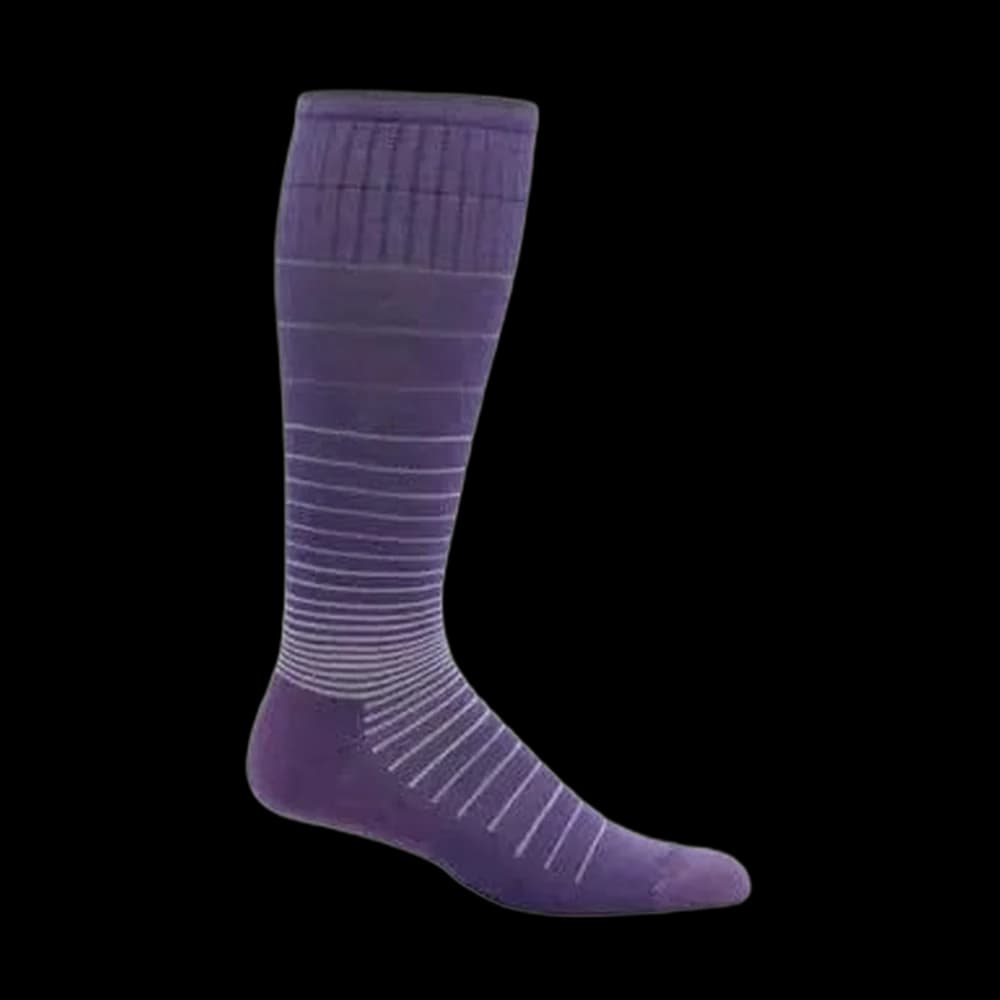
Sockwell Circulator Compression Sock
- 32% merino wool blended with bamboo rayon, nylon and spandex, per Sockwell
- 15-20 mmHg graduated compression with an ultra-light cushion underfoot
- Merino manages moisture and resists odor better than an all-synthetic knit
If your socks are going to end up in a dryer, buy one whose maker allows it. Sockwell states tumble dry low for its merino socks, while saying a cold wash and air dry give socks a longer life.
Side-by-side comparison
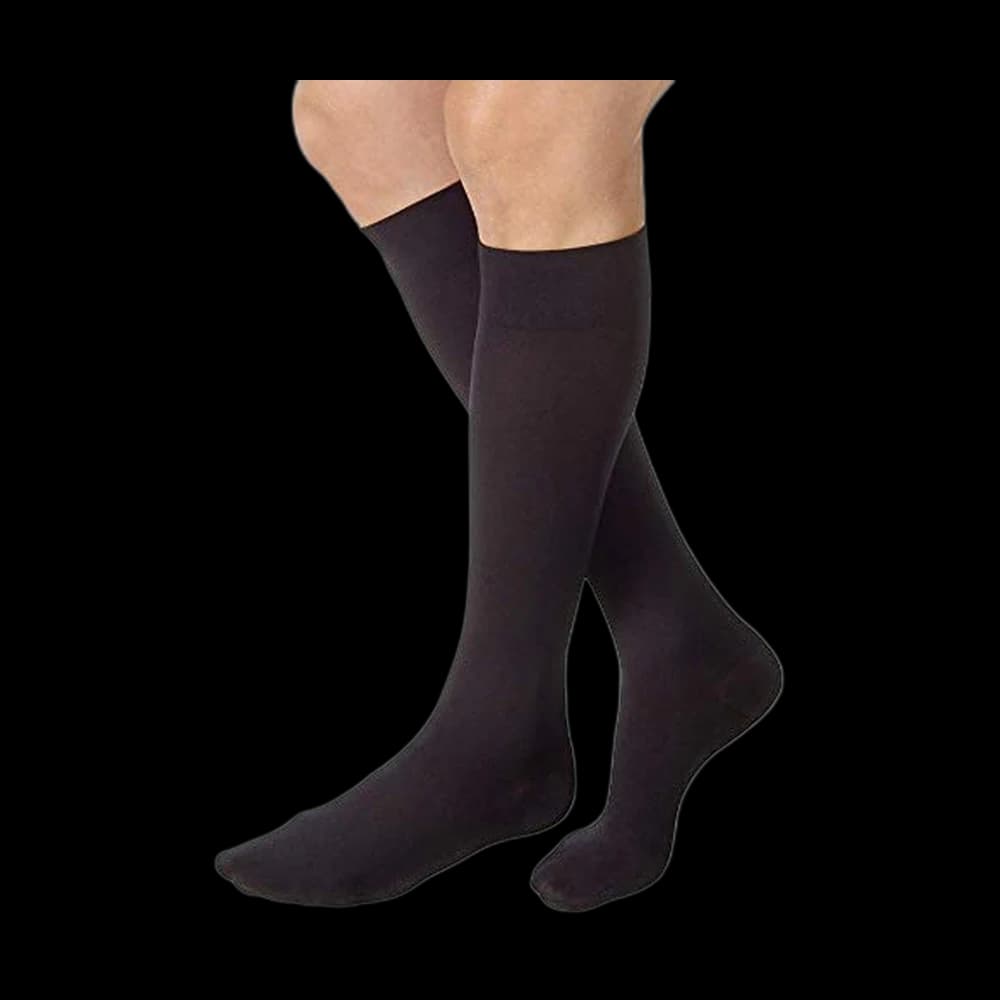
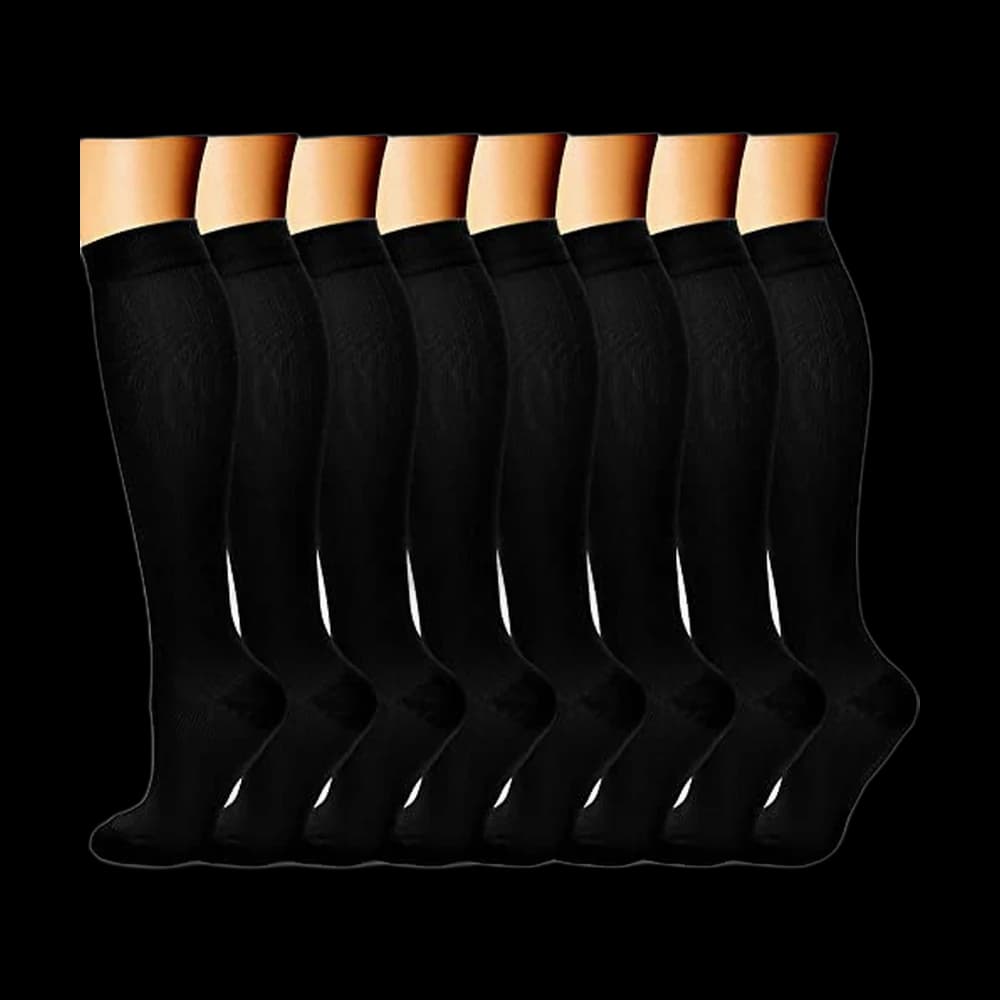
#1Sockwell Circulator Compression Sock Owner rating4.6(4,986) | #2JOBST Relief 15-20 mmHg Knee High Owner rating4.4(1,643) | #3CHARMKING Compression Socks, 8 Pairs Owner rating4.5(90,077) | |
|---|---|---|---|
|  |  | |
| NurseComforts Score | |||
| Verdict | The catalog sock with the most forgiving laundry rules: its maker allows a warm wash and a low-heat dryer. | A compression line whose FAQ allows flat drying or low heat, subject to the garment label. | Eight pairs covers even a six-shift, one-load week by our arithmetic. |
| Price | ~$32.95Buy on Amazon Main button: women's sizes | ~$32Buy on Amazon Price checked Nov 1 | ~$19.99Buy on Amazon Price checked Nov 1 |
| Compression Level (mmHg) | 15-20 mmHg, moderate graduated | 15-20 mmHg, graduated, as JOBST states | 15-20 mmHg, graduated |
| Fiber Content | 32% merino, 31% bamboo rayon, 32% stretch nylon, 5% spandex | Not stated on the listing | 85% nylon per the manufacturer; remainder not stated |
| Pairs Per Pack | 1 pair | 1 pair | 8 pairs |
| Buyer sentiment | Comfort Fit Compression Functionality Buyers praise comfort, fit, compression and functionality. Mixed feedback on value for money and ease of use. Based on 3,236 user mentions | - | Quality Comfort Functionality Appearance Buyers praise quality, comfort, functionality and appearance. Mixed feedback on fit and compression. Based on 26,302 user mentions |
| Pros |
|
|
|
| Cons |
|
|
|
* Prices are approximate. Click Buy to see current pricing on Amazon.
Wash compression socks inside out on a gentle cycle in cold to warm water with mild detergent, skip softener and bleach, then air dry. None of the makers we checked endorses hot water. Where they split is the dryer: some allow low heat, and one says even low heat does cumulative damage.
Many guides on this search flatten that into "never use a dryer." The makers' own pages do not agree, so what you bought decides how strict you need to be.
The dryer is where the makers split
Each cell comes from that maker's own care page. "Not stated" means the page we read does not say. JOBST and medi write about stockings, and medi's temperature carries no unit on its page, though it is a German maker.
| Maker | Water and cycle | Softener | Bleach | Dryer | How often |
|---|---|---|---|---|---|
| Sigvaris | Lukewarm; hand wash recommended, gentle machine cycle allowed | No | No | Avoid; air dry | Not stated |
| Comrad | Cold or cool; gentle cycle | No | No | Avoid, even on low | After every wear |
| Sockwell merino | Warm or cold; no hot water or harsh cycles | Avoid | No | Low heat, or air dry | Every 2 or 3 wears on regular-activity days |
| JOBST | Warm; low spin | No | No | Flat dry or low heat | Daily, or at least every other day |
| medi | 30 or 40 degrees; gentle cycle | Never | Not stated | Low setting, or air dry | Every evening |
| Physix Gear | Warm; hand wash recommended, machine allowed | Not stated | No | Air dry recommended, tumble allowed | Not stated |
Read your own label. JOBST's FAQ allows low-heat tumbling, but its JOBST Relief page tells you to check the garment label for dryer compatibility. We found no care page from CHARMKING or Wellow, so we left them out; for those socks, the label inside the pair is the instruction.
None of these pages publishes a test comparing air drying with low heat. Comrad's warning and Sockwell's permission are both maker statements. Air drying is the choice no maker here objects to, and low heat is a defensible fallback only where your maker allows it.
Why laundry changes the pressure
Compression comes from elastic fibers, and the makers name the same threats: heat, harsh chemicals and stretching.
- Heat: Comrad says dryer heat can degrade elastic fibers and shorten a sock's life. Sockwell says too much heat can damage the fibers and compromise the fit.
- Softener: Comrad says it coats fibers and reduces elasticity.
- Wringing: JOBST, medi and Comrad all say do not wring, and NHS inform says not to squeeze the water out.
Washing itself also helps. medi says its stockings regain their original elasticity after washing and drying, which is why skipping the wash is not the gentle option it sounds like.
The routine after a shift
- Turn the socks inside out.
- Put them in a mesh bag, which Comrad and JOBST both suggest for extra protection.
- Run a gentle cycle with a mild detergent, at the temperature your maker states. Cold or cool suits Comrad and is allowed by Sockwell.
- Roll them in a towel and press the water out. Do not wring.
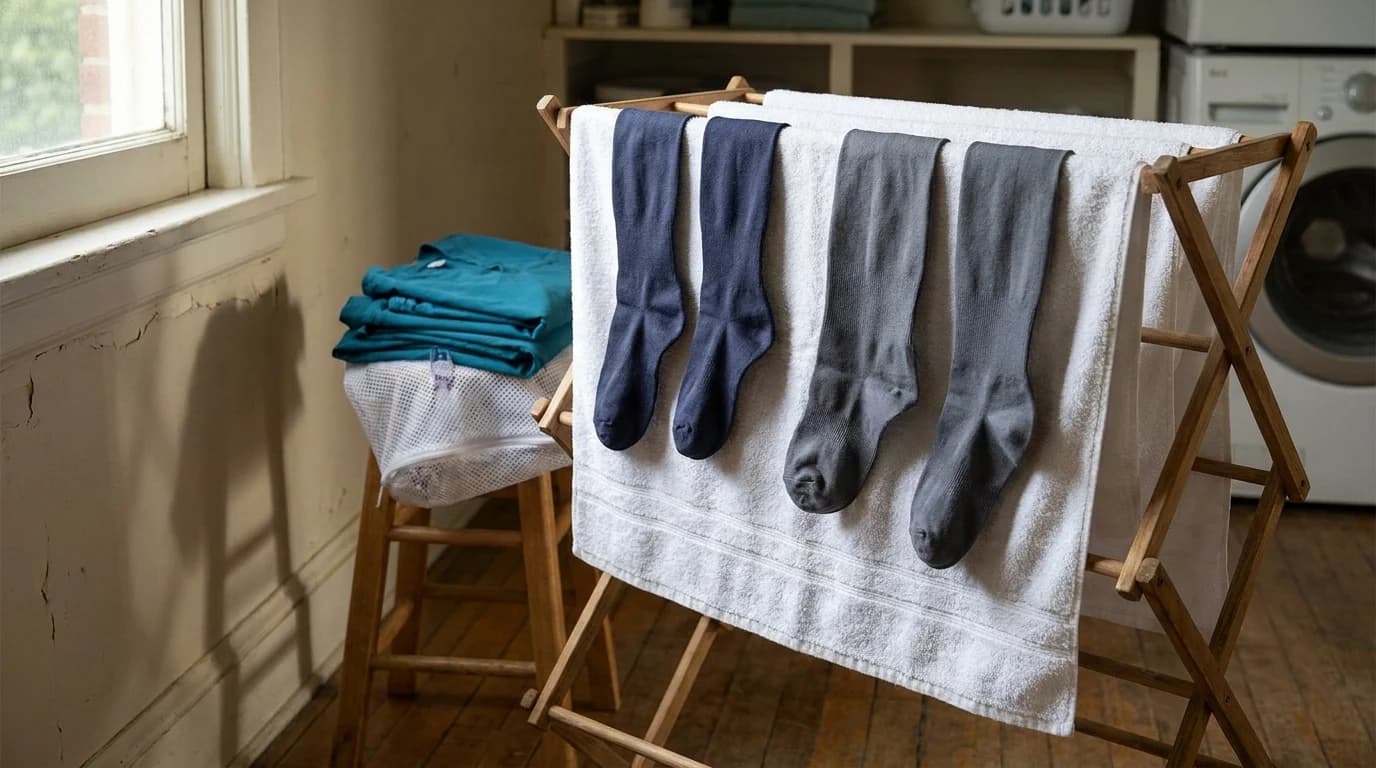
- Dry them flat or hung, away from radiators and direct sun. JOBST, medi and NHS inform all warn against a radiator.
If they have a silicone band, JOBST says to hand wash it to clear creams, lotions and hair.
Why they should not ride along with your scrubs
The routine in our scrub laundry guide uses the warmest water the label allows, oxygen bleach and a low-heat dryer. Socks want different settings.
| Scrubs may get | Socks need instead |
|---|---|
| Oxygen-based bleach | No bleach; the sock pages we read make no exception for oxygen types |
| Stain remover | None, per JOBST and Comrad |
| The warmest water the label allows | Your sock maker's stated temperature |
| A low-heat dryer | Air dry, unless your sock maker allows low heat |
So run them as a separate gentle load, or pull them out before the dryer if your scrub settings already suit your socks.
How many pairs a 12-hour week takes
MedlinePlus suggests two pairs, one worn and one washed and dried. That floor assumes you wash every day. The table below is our arithmetic, not a maker's figure: one clean pair per shift, plus one spare.
| Your week | Shifts between washes | Pairs to own |
|---|---|---|
| Three 12s, washed after each shift | 1 | 2 |
| Three 12s, one load at the end | 3 | 4 |
| Six 12s, a load after every third shift | 3 | 4 |
| Six 12s, one load at the end | 6 | 7 |
A multipack such as CHARMKING, 8 pairs covers the worst row, though you will need to follow its label for care. If you want your dryer to stay part of the routine, Sockwell Circulator and JOBST Relief are the catalog socks whose makers leave that door open, subject to the label on the JOBST pair. Comrad's 3-pack suits you if you already air dry, and Physix Gear Sport sits in the firmer 20-30 mmHg20-30 mmHgThe firm band of compression hosiery, often labelled by sellers as 'medical grade' - a marketing phrase, not a regulatory classification. It is harder to don than 15-20 mmHg and is frequently the band nurses report their own clinicians discussing. Which band suits a given person is a question for that person's clinician, not a review site. band a clinician may point you to.
When a pair is done
The replacement numbers differ, and they are stated as time, not washes.
| Source | Stated lifespan |
|---|---|
| MedlinePlus | Replace every 3 to 6 months |
| Comrad | Typically 4 to 6 months of regular wear |
| JOBST | Every six months under normal daily use |
| medi | Replaced in six months' time |
| Physix Gear | About 6 to 8 months; order new at six |
Our arithmetic on that: three shifts a week for 26 weeks is 78 wears. Across four pairs that is about 20 wears each, while two pairs worn daily would reach about 91 each. No source gives a wear count, so this does not prove a rotated sock lasts longer. It does mean six months is a good date to check your socks, and that the check should decide.
Retire a pair when: it slips or sags, or feels less firm (Comrad), looks worn or stretched out (Cleveland Clinic), or fits noticeably looser or tighter than when new (JOBST, which sends you to a fitter or clinician). Our fit check is the quick way to test it on shift.
If a clinician prescribed your stockings, the leaflet in the box and their advice outrank everything here. Our guide to mmHg bands covers what firmness to ask about, and how long to wear them covers the shift itself.
Common questions
Can you put compression socks in the dryer?
Can you use fabric softener on compression socks?
How often should nurses wash compression socks?
Do compression socks lose compression from washing?
Research Sources
- How to clean compression products | SIGVARIS
- How to Wash Your Compression Socks | Comrad
- FAQ: how to wash Sockwell merino wool socks | Sockwell
- How Do You Wash Compression Socks to Make Them Last Longer? | Sockwell
- Frequently Asked Questions: garment care and replacement | JOBST
- JOBST Relief: how to care for the product | JOBST
- Taking care of compression stockings | medi
- FAQ: washing instructions and sock lifespan | Physix Gear Sport
- Compression stockings | MedlinePlus
- Compression stockings and socks | NHS inform
- Compression therapy | Cleveland Clinic