Our #1 Pick
The Bondi is HOKA's maximum-cushion road shoe, and this is the standard Bondi 9 build: engineered mesh upper, textile lining, and the thickest foam stack HOKA puts under a daily trainer. It earns the top cushioning slot here because nothing else in this category puts that much material between your heel and hospital tile, and HOKA lists it at 9.3 oz in the women's build. The honest tradeoff is that this is not the Bondi SR work version: the mesh upper soaks rather than wipes, and the road outsole carries no slip-resistance certification, so check your unit's footwear policy before you commit.
Road build, not the Bondi SR: HOKA states no slip-resistance rating, and the engineered-mesh upper cannot be wiped down. Check your unit's footwear policy first.
Fits: Regular, Wide and X-Wide: women's US 5–12 and men's US 7–16 in all three, per the Amazon listings
Key takeaways
- Cushioning is roughly half the decision. Your workplace's slip-resistance rule and whether the upper wipes clean decide the other half, and they decide it faster.
- Two rotated pairs at a moderate price beat one premium pair worn daily, because foam needs a day to decompress and a wet shoe needs longer to dry.
- Midsole foam fails silently, usually two to three seasons before the shoe looks worn out. Diarize a replacement date instead of waiting for pain.
- If your legs ache rather than your heels, the problem is above the ankle and no shoe fixes it. That is the compression sock conversation.
- Before spending on new shoes, check whether the ones you own have a removable factory footbed. A work insole is the cheapest real upgrade available.
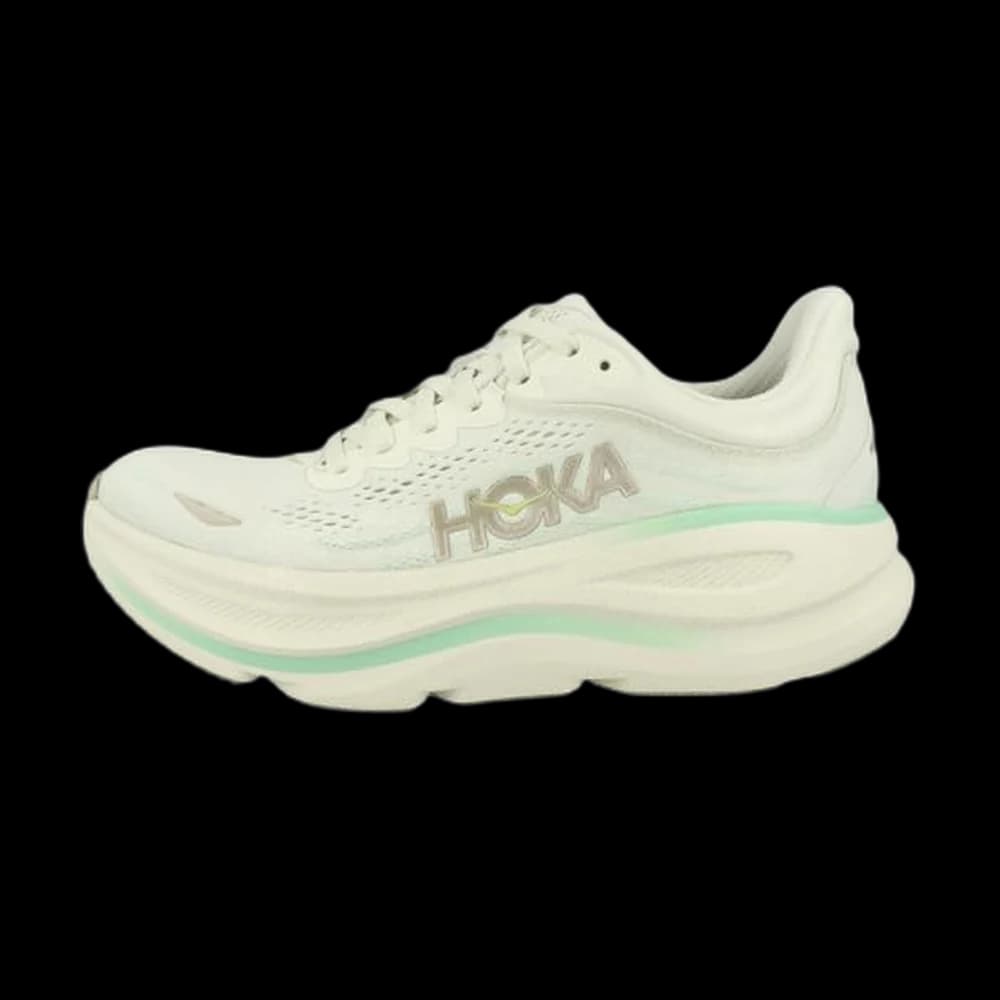
HOKA Bondi 9
- Maximum-cushion HOKA platform, the deepest foam stack among the shoes here
- HOKA lists the women's Bondi 9 at 9.3 oz, light for how much foam is underfoot
- Engineered mesh upper breathes well on a warm unit, unlike leather work shoes
For anyone standing on a hard floor whose employer does not require a rated slip-resistant outsole, nothing here puts more foam under your heel, and the rocker shape keeps you moving late in a long shift. Check your workplace footwear policy first, because this is the road build rather than the slip-resistant Bondi SR.
Fits: Regular, Wide and X-Wide: women's US 5–12 and men's US 7–16 in all three, per the Amazon listings
Side-by-side comparison
#1HOKA Bondi 9 Owner rating4.5(3,217) | #2Skechers Work Arch Fit 2.0 SR Rosraine Owner rating3.8(13) | #3Brooks Ghost 18 Owner rating4.4(804) | #4Dansko XP 2.0 Clog Owner rating4.4(14,743) | #5PowerStep Pinnacle Work Insole Owner rating4.4(3,107) | #6Physix Gear Sport 20-30 mmHg Compression Socks Owner rating4.4(42,744) | |
|---|---|---|---|---|---|---|
|  |  |  |  |  | |
| NurseComforts Score | ||||||
| Verdict | The most foam you can get between your heel and a hard floor, for anyone whose workplace does not audit the outsole. | The only shoe here that is both wipeable and stated by its maker to be slip-resistant, which makes it the default where a footwear policy is actually enforced. | The value pick among the running shoes for jobs where you cover ground rather than stand in one spot. | The kitchen and wet-floor answer, and the only clog here whose footbed comes out for a standard or custom orthotic. | The cheapest genuine upgrade on this page, if the shoes or boots you already own have a removable factory footbed. | For the ache that lives in your calves rather than your heels, which is the complaint no shoe on this list solves. |
| Price | ~$174.95Buy on Amazon Main button: women's sizes | ~$100.00Buy on Amazon Price checked Oct 10 | ~$133.99Buy on Amazon Main button: women's sizes | ~$164.95Buy on Amazon Main button: women's sizes | ~$44.99Buy on Amazon Price checked Oct 10 | ~$18.82Buy on Amazon Price checked Oct 10 |
| What It Does | Maximum-cushion daily trainer | Slip-rated cushioned work sneaker | Balanced cushioned daily trainer | Wipeable professional clog, slip-resistant per the maker | Replacement work footbed, neutral arch | Graduated compression, 20-30 mmHg firm tier |
| Slip-Resistance Rating | None stated; road outsole | Slip-resistant outsole with electrical hazard protection per the listing | None stated; road outsole | Rated by Dansko for dry, wet and oily-wet | Not applicable; goes inside the shoe | Not applicable; worn inside the shoe |
| Cleanability | Engineered mesh, not wipeable | Breathable leather, wipes clean | Engineered air mesh, not wipeable | Waterproof pull-up leather, rinseable | Wipe or air out; not machine washable | Machine washable; elasticity is the wear item |
| Expected Service Life | Two to three seasons of full-time shifts | One to two seasons of full-time shifts | Two to three seasons of full-time shifts | Two to four seasons; the longest-lived pick here | Six to twelve months of full-time use | Treat as seasonal, roughly six months in rotation |
| Buyer sentiment | Fit Comfort Arch Support Foot Relief Buyers praise fit, comfort, arch support and foot relief. Mixed feedback on value for money and size. Based on 1,775 user mentions | - | Fit Comfort Arch Support Appearance Buyers praise fit, comfort, arch support and appearance. Based on 625 user mentions | Appearance Comfort Arch Support Work-Friendly Durability Buyers praise appearance, comfort, arch support and work-friendly. Mixed feedback on fit and value for money. Some flag durability. Based on 5,785 user mentions | Quality Comfort Effectiveness Arch Support Durability Arch Height Buyers praise quality, comfort, effectiveness and arch support. Some flag durability and arch height. Based on 905 user mentions | Quality Comfort Compression Support Size Buyers praise quality, comfort, compression and support. Mixed feedback on fit and ease of use. Some flag size. Based on 20,650 user mentions |
| Pros |
|
|
|
|
|
|
| Cons |
|
|
|
|
|
|
* Prices are approximate. Click Buy to see current pricing on Amazon.
If you are on your feet for eight to twelve hours a day, the single best thing you can buy is a well-cushioned shoe that meets your workplace's floor rules — and then a second pair of the same thing. For most people on hard floors the pick is the HOKA Bondi 9, which puts more foam between your heel and the slab than anything else at this price. If your employer requires a rated slip-resistant outsoleslip-resistant outsoleAn outsole compound and tread pattern intended to keep traction on wet or contaminated floors. Testing is not uniform: some brands cite an ASTM or SATRA coefficient-of-friction result, most simply print the phrase on the box. Where a manufacturer names the standard we say so; where it only claims 'slip-resistant' with no standard behind it, that is all the claim is worth., or your floor is wet more often than not, the Skechers Work Arch Fit 2.0 SR Rosraine is the honest answer at roughly two-thirds the money. In a kitchen or a clinical setting where the shoe gets soaked and wiped, a Dansko XP 2.0 Clog outlasts both.
The thing almost every "best shoes for standing all day" list gets wrong is treating cushioning as the whole problem. It is maybe half. The other half is whether the outsole is actually rated for your floor, whether the upper survives being wiped down, and whether you are still wearing the same pair two years after the foam quit. Canada's Centre for Occupational Health and Safety, which publishes one of the plainer guides to standing work, lists sore feet, leg swelling, varicose veins, general muscular fatigue and low back pain as consequences of prolonged standing — and its footwear guidance is unglamorous: shoes that allow the natural shape of your foot, real arch supportarch supportThe height and firmness of the contoured section under the medial arch of a footbed or insole. 'Support' is not one thing: insoles are sold in low, neutral and high arch profiles, and a high-arch insole under a low-arch foot is the most common cause of the 'these hurt' review. Arch height is a fit question, not a quality ranking., laces tightened at the instep, no high heels. Nothing about foam stack height at all.
The short version, by what you do
| Job | Floor reality | Where we'd start |
|---|---|---|
| Hospital, clinic, lab | Vinyl over concrete, occasional spills, long distances | Max-cushion sneaker, or a slip-rated work shoe if policy requires |
| Kitchen, food service | Wet, greasy, hot spills, frequent hosing | Wipeable slip-rated clog |
| Retail, grocery | Concrete or tile, moderate distance, dress-code pressure | Cushioned trainer or a wipeable work sneaker |
| Warehouse, distribution | Sealed concrete, high step count | Cushioned trainer with a durable outsole |
| Teaching, classroom | Tile or carpet, all-day standing, low spill risk | Cushioned trainer, comfort over rating |
| Trades, shop floor | Concrete, debris, safety-toe requirements | Work footwear that meets your site's PPE rules first |
Notice the pattern: only two of those six rows are actually solved by "more foam." The rest are solved by matching the shoe to the hazard.
What decides this, and it is not cushioning
Slip resistance is a rating, not an adjective
A running shoe outsole is tuned for dry asphalt. It is not tested for a wet tile floor with a film of grease on it, and no amount of rubber makes it so. Plenty of employers — hospitals, restaurant groups, grocery chains — publish a footwear policy that requires a rated slip-resistant outsole, and a road trainer will not satisfy it no matter how good it feels.
Read your own policy before you spend. If it requires a rating, your shortlist shrinks fast and the answer is a work shoe or a clog, not a marathon trainer. If it does not, you have the whole running-shoe world open to you, which is where most of the good cushioning lives.
Cleanability decides how long the shoe lasts
Mesh uppers breathe beautifully and absorb everything permanently. If your day involves fluids — clinical or culinary — a mesh shoe is a consumable on a much faster clock than a leather or synthetic one, and it will start to smell before it stops supporting you. A wipeable upper is not a comfort feature, it is a lifespan feature.
This is the single reason clogs still dominate kitchens and some clinical units decades after everyone else moved to sneakers. You can rinse a Dansko in a mop sink.
Midsole foam is a consumable and it fails silently
Foam compresses. It stops rebounding long before the upper looks worn, so the shoe fails quietly and you blame your feet, your age or the floor. Most people working full-time shifts get two to three seasons of real support out of a pair. Put a replacement date in a calendar rather than waiting for pain to tell you.
This is also the whole argument for owning two pairs instead of one expensive pair. Foam needs about a day to decompress, and a wet shoe needs longer than that to dry. Two rotated pairs at a moderate price genuinely outperform one premium pair worn every single day, and you always have a dry shoe.
Our picks by worker type
1. HOKA Bondi 9 — hospital, clinic and lab floors
Check price on Amazon →Hospital floors are concrete with a thin sheet of vinyl on top. There is no give in them, and the distances are long. The Bondi is HOKA's maximum-cushion daily trainer and carries the deepest stack here, with a Meta-Rockerrocker soleA sole with a curved profile that rolls the foot forward through each step instead of flexing it. Common on nursing clogs and recovery shoes. Wearers who like them describe less forefoot fatigue on long shifts; wearers who dislike them describe a tippy feel that takes a week to adjust to. geometry that nudges you forward instead of asking your calves to push off from flat. HOKA lists the women's build at 9.3 oz, which is remarkably light for the amount of foam involved. Around $170.
The caveat that most write-ups skip: this is the road build, not the slip-resistant Bondi SR. Engineered mesh upper, no slip-resistance certification. It is superb on a dry unit and the wrong tool for a policy that requires a rating.
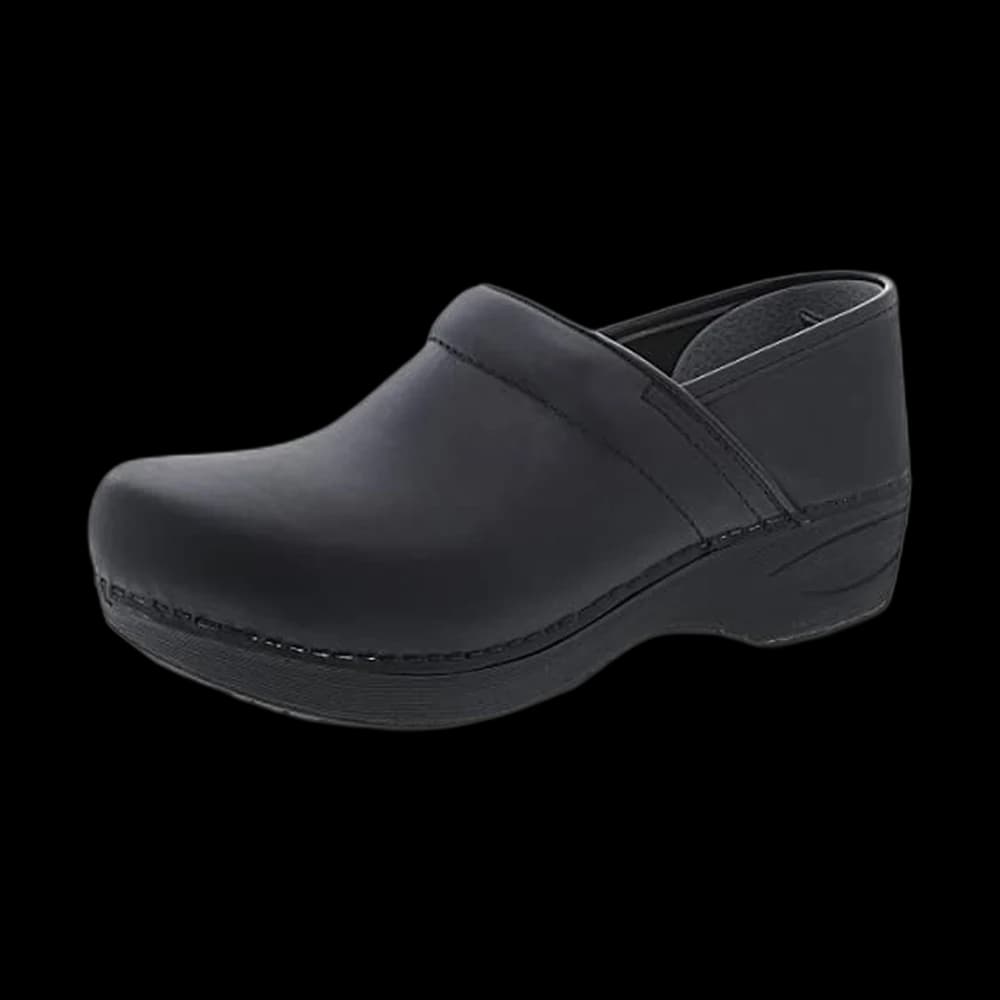
2. Dansko XP 2.0 Clog — kitchens and wet clinical floors
Check price on Amazon →The XP 2.0 is the reference clog, and it earns that on two features rather than on comfort marketing. Its footbed is removable, so a standard or custom orthotic actually fits — almost no other clog allows that. And Dansko rates the outsole for dry, wet and oily-wet floors, which is the specific condition a kitchen line lives in. A waterproof leather upper means you can hose it, wipe it, and go again. Around $165, which is the most expensive thing on this page and also the thing most likely to still be working in three years.
The honest tradeoff is the open back. It is poor for stairs, poor for anything resembling a sprint, and takes a week or two before your foot stops fighting the fixed heel. Cooks put up with it because a backless shoe can be kicked off in a hurry when something hot lands in it, which is a real and specific reason.
If clogs are your world, our nursing clogs shortlist compares five of them on footbed removability and outsole rating.
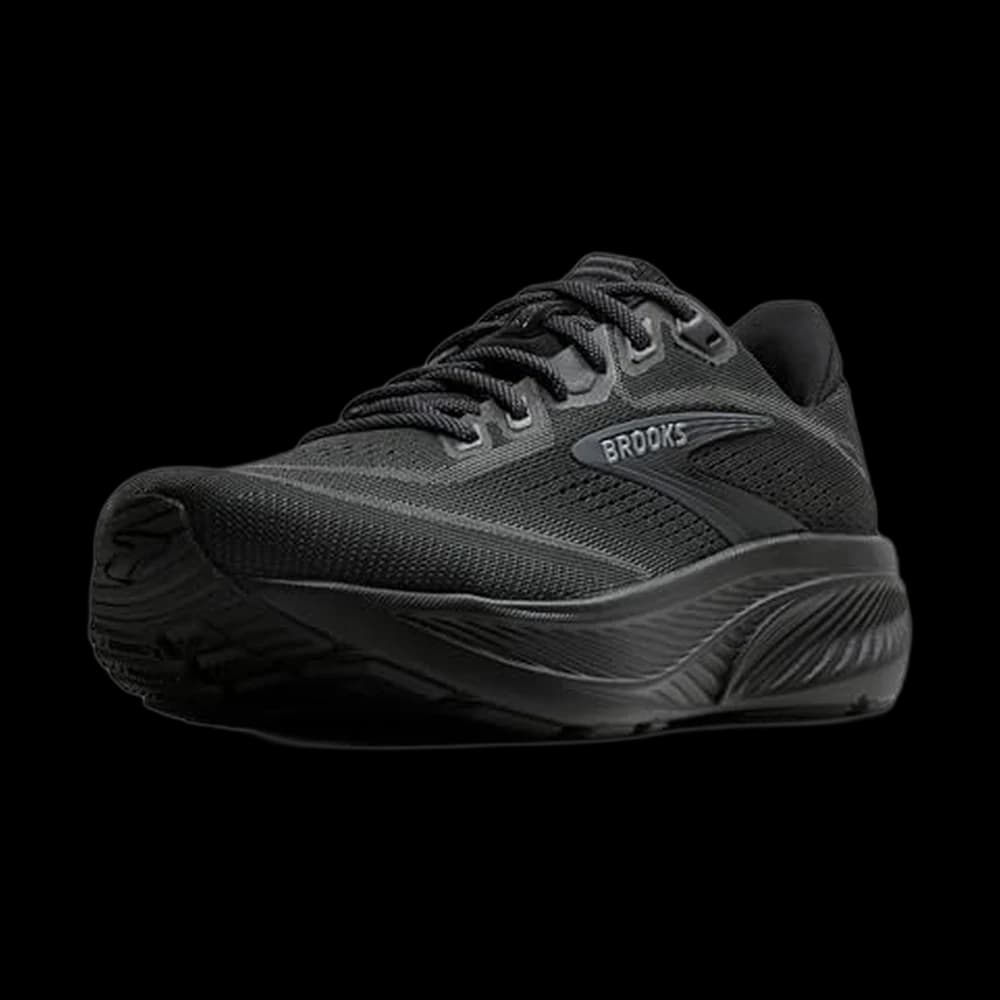
3. Brooks Ghost 18 — retail, grocery and warehouse
Check price on Amazon →If you cover ground rather than standing in one spot, the Brooks Ghost 18 is the value pick among the running shoes. Nitrogen-infused DNA LOFT v3 foam, a new Ortholite X-60 sockliner, a genuinely breathable mesh upper and a price around $135, the lowest of the running shoes on this page, which makes rotating two pairs more realistic. Brooks lists it as carrying the APMA Seal of Acceptance — worth knowing exactly what that means, which we cover below.
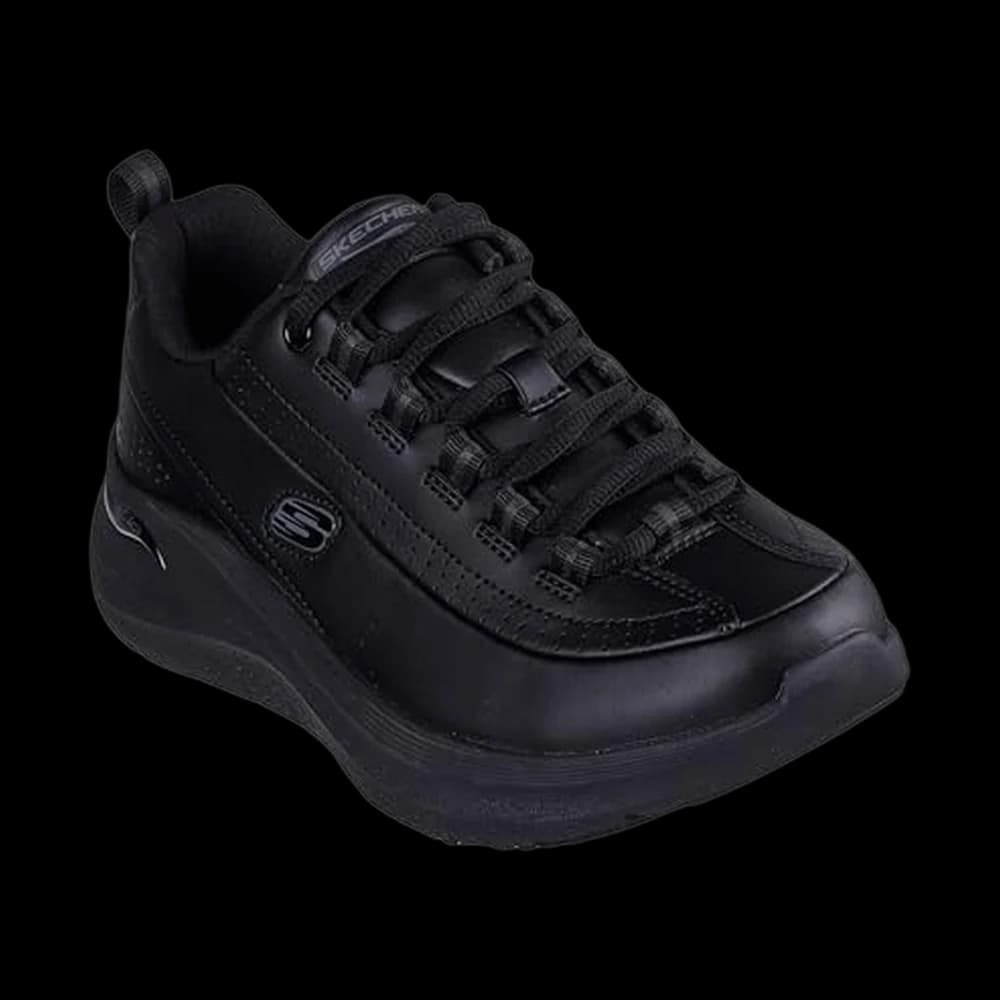
4. Skechers Work Arch Fit 2.0 SR Rosraine — where your employer checks the outsole
Check price on Amazon →Where a rating is required, this is the one shoe on this page that is both wipeable and stated by its maker to be slip-resistant, with a leather upper and electrical-hazard protection per the listing, at around $100. Its cushioning stack is thinner and packs out sooner than the premium picks, and it is not our first suggestion if you have diagnosed heel pain — but it is the honest answer for anyone whose employer checks.
Teaching, front desk and dry floors generally
If nobody is auditing your outsole and your floor is dry, you are shopping for comfort with no constraints. A cushioned neutral trainer that fits your foot shape beats a shoe with better marketing every time. Buy at the end of the day, when your feet are the size they will actually be at hour ten.
Trades and shop floors
PPE rules come first. Safety-toe and puncture-resistance requirements narrow the field to work footwear before comfort enters the conversation, and nothing on this page substitutes for a boot your site requires. What does transfer is the insole advice below — swapping the flat factory footbed in a work boot is the cheapest real upgrade available in the trades.
Best shoes for standing all day, by job
People ask this by job title, so here is the one-line answer for the jobs that ask most.
CNAs and nursing assistants
The Skechers Work Arch Fit 2.0 SR Rosraine: lifting, walking and bodily fluids call for an upper that wipes clean and an outsole that is slip-resistant per Skechers, at around $100. If your facility has no footwear policy, a cushioned trainer like the Brooks Ghost 18 is the comfort pick. Our best shoes for CNAs page goes deeper.
Lab, surgical and pharmacy techs
If you stand in one spot for a case or at a bench, a clog's rocker sole does more than extra foam, so start with the Dansko XP 2.0 Clog; where the shoe itself has to be sterilized, our nursing clogs guide covers the autoclavableautoclavableAble to withstand steam sterilisation at autoclave temperature and pressure without deforming. It appears on some clogs, shears and instrument specs. It describes material tolerance only - what actually gets processed, and how, is set by facility policy. Calzuro.
Teachers
The Brooks Ghost 18: classroom floors are usually dry and nobody audits your outsole, so a cushioned neutral trainer that fits your foot shape is the answer, and it is the cheapest running shoe on this page.
Hairstylists and barbers
The Dansko XP 2.0 Clog for standing behind the chair: its waterproof leather upper wipes clean, and the removable footbed takes an orthotic. See our best shoes for hairstylists page for more options.
Servers and restaurant workers
The Skechers Work Arch Fit 2.0 SR Rosraine: restaurants commonly require a slip-resistant outsole, and a closed lace-up suits fast walking better than an open-back clog. Check your employer's policy first.
Retail and grocery
The Brooks Ghost 18: concrete or tile, moderate distance and no spills to speak of, so a cushioned trainer you can afford to rotate wins. Add a work insole if your feet still ache at closing.
Nurses
See If you are a nurse specifically below, and our full best shoes for nurses ranking.
Fix the shoes you already own first
Before you spend $160, spend $45. Many work shoes and nearly all work boots ship with a thin, flat die-cut footbed that exists to make the shoe stackable in a box. Replacing it changes the shoe more than most people expect.
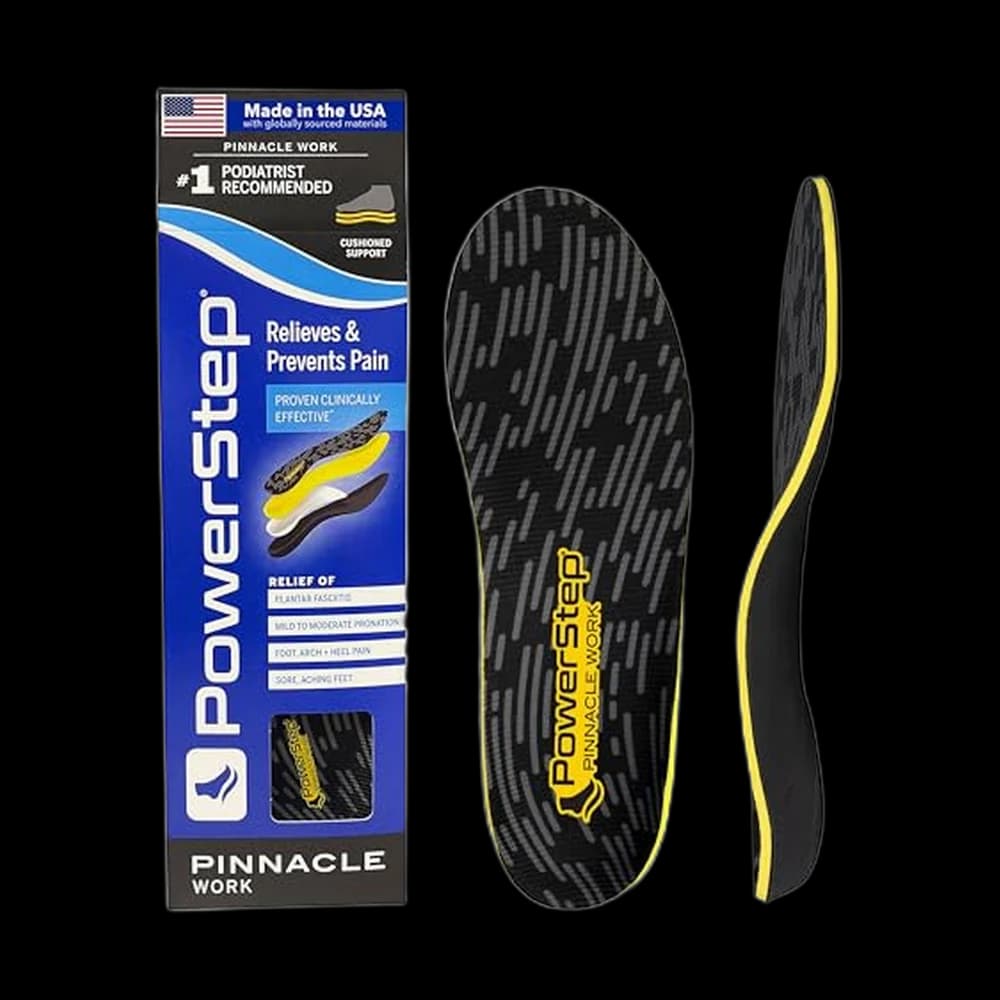
The PowerStep Pinnacle Work Insole is built for work footwear rather than adapted from a running product: a firm-but-flexible contoured neutral arch, a deep heel cradleheel cupThe moulded rear section of an insole or footbed that surrounds the heel. A deeper cup keeps the heel pad centred under the calcaneus and resists side-to-side motion; a shallow cup lets the heel spread and slide. Depth is the spec most commonly cited by insole makers and the one owners most often mention. and a dual-layer cushion designed to resist going flat. Around $45. Two rules make or break it — pull the stock insole out first rather than stacking on top of it, and match the volume, because a thick work insole crowds a slim running shoe.
One warning that saves money: a high-arch insole under a low arch is uncomfortable and useless, and the reverse is worse. Know your arch before you buy. Our full insoles for standing all day comparison walks through the arch question and six specific inserts, and the shift insoles category has the rest.
The pick nobody asks for: compression socks
This is the one recommendation on this page that consistently surprises people, and the one that gets the most "I should have done this years ago" reaction. If your complaint is heavy, aching legs and swollen ankles at the end of a shift rather than sore heels, no shoe is going to fix that — the problem is above your ankle, not under it.
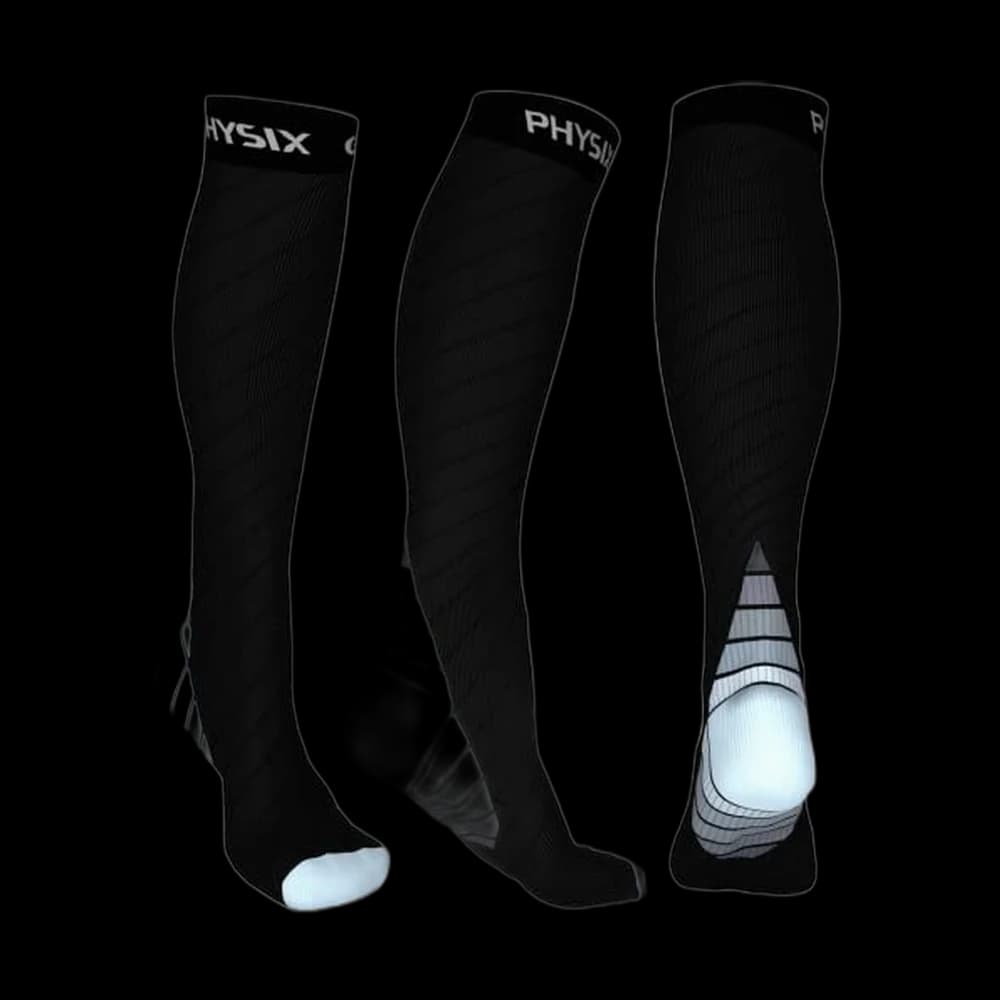
Graduated compressiongraduated compressionCompression that is strongest at the ankle and eases as it travels up the calf. The gradient is what distinguishes a compression sock from a merely tight sock. Manufacturers state the ankle band in mmHg; independent verification of the gradient across the leg is rare, so treat the stated band as a manufacturer claim. socks are tightest at the ankle and ease off up the calf. For most people new to them, the 15-20 mmHgmmHgMillimeters of mercury, the pressure unit used to rate compression socks and blood-pressure readings. Compression hosiery is sold in bands - commonly 8-15, 15-20, 20-30 and 30-40 mmHg - and the number describes pressure at the ankle, not an average over the whole leg. tier is the starting point. The Physix Gear Sport 20-30 mmHg Compression Socks sit in the firmer tier at around $19, which is where people usually end up after 15-20 stops doing enough — noticeably harder to pull on, and not where we would suggest starting. The compression socks category covers both tiers, and our compression socks for nurses comparison explains graduated compression and pack sizing properly.
One boundary worth stating plainly: swelling, persistent leg pain and visible vein changes are things to raise with your clinician, not to self-treat with a purchase. Compression garments are a comfort tool here, not a treatment plan, and if you have a known circulatory condition the mmHg tier is a conversation to have with them first.
What "APMA Seal" and similar badges actually mean
You will see the APMA Seal of Acceptance on a lot of shoes and insoles marketed for standing work. APMA's own FAQ is refreshingly direct about it: the Seal "is not an endorsement, but a recognition granted to products" — it means a company submitted the product and documentation and a panel found it beneficial to foot health. Useful context. It says nothing whatsoever about slip resistance, cleanability or how long the foam will last, which are the three things that actually decide this purchase.
Sizing, rotation, replacement
Size for hour ten, not hour one. Most people are effectively half a size larger at the end of a long shift. A shoe that fits perfectly at 7 a.m. can be punishing by 7 p.m., and a lot of what gets blamed on "not enough cushioning" is actually a width problem. Get your width measured; it is more valuable than sizing up blindly.
Rotate two pairs. Cheapest upgrade on this page, for the foam-recovery and drying reasons above.
Change position when you can. CCOHS's guidance for standing work is to change working positions frequently and to use a foot rail or portable footrest to shift weight from one leg to the other. It also cautions against very thick foam-rubber mats — too much cushioning causes fatigue and adds a trip hazard, which is the opposite of what most anti-fatigue mat marketing implies.
If you are a nurse specifically
Everything above applies to you, but nursing has a few constraints the general case does not: unit footwear policies that actually get enforced, uppers that need to survive being wiped with the same disinfectant as everything else, and step counts that put a lot of nurses well past what a retail shift demands. We went deeper on exactly that in best shoes for nurses, which compares six shoes on slip-resistance rating, wipeability and cushioning depth, including the healthcare-specific options that never show up on general lists. The nursing shoes category has the full shortlist.
The honest close
There is no shoe that makes twelve hours on concrete feel like six. What there is: a shoe matched to your floor's actual hazard, a second pair so neither is ever worn out or wet, an insole if the shoes you own are fixable, and compression socks if the ache is in your calves rather than your heels. Four decisions, and most people get about half of them right.
| Pick | Price | Slip resistance stated | Upper | Where this page puts it |
|---|---|---|---|---|
| HOKA Bondi 9 | $174.95 | None stated; this is the road build, not the Bondi SR | Engineered mesh with textile lining, not wipeable | Hospital, clinic and lab floors, where no rating is required |
| Brooks Ghost 18 | $133.99 | None stated | Engineered air mesh, not wipeable | Retail, grocery and warehouse, where you cover ground |
| Skechers Work Arch Fit 2.0 SR | $100.00 | Slip-resistant outsole with electrical hazard protection, per the listing | Breathable leather, wipeable | Any floor where your employer checks the outsole |
| Dansko Professional XP 2.0 Clog | $164.95 | Rated by Dansko for dry, wet and oily/wet surfaces | Waterproof pull-up leather, rinseable | Kitchens and wet clinical floors |
Your next step